Showing posts with label Evan. Show all posts

Tuesday, January 3, 2012

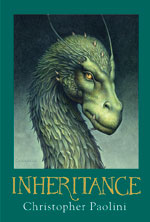
Inheritance, by Christopher Paolini - shared review since we both read it


Evan:
Despite our
previous posts, we weren't quite impatient enough to spring for buying this book ourselves. So - the library having a mile-long hold list - we had to wait until we could borrow a copy from some friends of ours who had.


Rina:
To any of you who will be reading this review, you already know the plot of the Eragon novels. To those who haven't read the previous 3.... why read the review of book 4? So... I can skip a plot outline... which I really don't like to write, so all's well.


We'll try not to spoiler anything important (white text on white is good!) but if you really want to go into the last installment of the series with no prior knowledge, we'll be discussing it in enough depth that you might want to leave now...

Evan:
Inheritance definitely rises above its predecessors to bring the tetralogy to a more-than-fitting conclusion. Paolini had already shown us about as violent villains as he could in Durza, Morzan, and other imperial commanders - how could he beat that when finally showing us the ultimate villain, Galbatorix? But with the insight of a good author, he switched the playing field! The evil emperor doesn't fight but speaks - in arguments that sound sensible and even true - making me wonder for a minute whether even the author was on his side! But then I saw the subtle flaw, and I marveled at Paolini's newfound skill. (Galbatorix describes for us a real problem, but he doesn't mention that he hasn't even begun to fix it. And even if he does unify all mages under him, how can we trust him? Can even magic oaths bind him who knows the Name of the Language?) When Eragon finally confronts Galbatorix, he doesn't win a cheap triumph with an obvious move like too many other protagonists. Rather, the evil mastermind shows us (not tells us!) that he can and has defeated myriads of other would-be heroes - and Eragon finally takes him down in a completely unexpected way that left me cheering and marveling.

The author's narrative and description skills have grown like a hungry dragon, too. Clunky prose and second-cousin-to-the-right-word's are definitely still in abundance, but there are real gems in there - like when the curtains behind Galbatorix's throne draw themselves back, with four truly excellent paragraphs, to reveal themselves as the black wings of Shruikan. Or, when Eragon and Saphira are thrown up by a huge storm and skim the tips of the atmosphere... A couple pages into the book, I decided to skim most of the words lest I cringe at every awry metaphor or abuse of syntax. But I just couldn't hold myself to that. I needed to slow down and admire the jewels - if not as big as those on the belt of Beloth, at least as shimmery as Saphira's scales.

Rina:
(Now that you mention it, we never did find that belt. What'd they do with it, anyhow?)

My main problem with Inheritance was that I felt the greatest parts of the story were weighed down by a lot of... not so great parts. There were moments that made me gasp with excitement (though not many), moments that made me go, "oh, awwwww" in a very happy and satisfied way, moments that kept me glued to the page, and moments that bored me.


I'm afraid Paolini has just tried to follow too many threads, and he's not got the greatest idea of what belongs in his story and what doesn't. Three chapters describe one battle from Roran's perspective - the attack of a city we've never seen before and never see again - but we still have a number of unresolved plot points that taggle off into nothing, which seems to me just a shame.


Evan:
One reviewer didn't read any chapters narrated by Roran, and he said he didn't feel he was missing anything. I wouldn't go that far. Roran's character development is somewhat satisfying in itself, his mature observations on the nature of magic give needed perspective to that issue, and his narrative during the battle at UrĂ»'baen gives us a sense of vastness that Eragon's narrative is missing. (Plus, his comment once that he knows he doesn't have skill but just luck [i.e. authorial intervention] is unintentionally hilarious.) Still - and in retrospect, this problem's been plaguing Roran's narrative ever since the first cut back to him at Carvahall - Paolini doesn't successfully draw him into the main plot thread. If all Carvahall had died, would that have made the least difference to Eragon's efforts? Well, they did rescue Jeod, who pulled a valuable detail out of a book... but other than that, not much. Similarly, all Roran's valiant and intrepid battle leadership doesn't seem to affect what Eragon is doing. Paolini could probably point us to several conversations where characters try to point out how it's vital - and yes, after a lot of reflection, I see it is. But a better author (such as I'm confident Paolini will become) would show his readers that rather than just stating it, so they'll see it without having to spend a while mulling it over.


And this's just one example of a myriad details - such as those sprawling across the hundred post-climactic pages - that, however interesting or even good in its own right, haven't been drawn into the central thread of this book. Oh, yes, Brigid bears a grudge against Roran from Book II. If brought up in some battle, this could've been great suspense! But she and the author left it hanging till after the climax, when it's little more than academically interesting. There's more than enough material in here for a good book, a much better book. Paolini's learned between his first book and now to put that in. I'll be watching his future books for him to learn to draw that together.

Rina:
Also, it's just clumsily written. I'm sorry, but it is. Paolini is fond of metaphors to the point of distracting the reader, and his prose is quite uninspired for the most part. His characters have improved over the books, and his dialogue shows flashes of goodness, but I couldn't help feeling that the author was banging on the wrong notes most of the time when it came to word and sentence and phrase.


I feel a little sorry for this book - and the author. There, I've said it. Perhaps no one believes me, but I wish Paolini and an editor had really sat down and took another big-picture look before publication. There was so much that could have been fixed and made better, so much that was snarled up with unnecessary flyaway strands, so much potential.

I hope Christopher Paolini writes more. A lot more. I think he's called his life-work right: to be a writer. I'm hoping he's not going to be hindered or held back by the success that came early, for like his characters, he's got what he needs and only lacks training and time. I hope and believe there will be a day when the Inheritance tetralogy is just his "early works" and he's gone beyond anything he's written yet.

Age rec - Phew. Tough one here. Paolini has a fascination with battle scenes that I don't share in the least, and they can get a little detailed - though I wasn't disgusted or disturbed (except by the fact that I was bored in the middle of a battle, which seems wrong).

There's all the torture scenes involving Nasuada - again, handled lightly and well for the most part. However, though Evan may shrug, there's a very nasty and definitely unfortunate chapter later in the same plot thread, and I do not recommend it for anyone young or faint-hearted. I skimmed (Evan and I were reading together) and mentally went, "Hey, not bothering here. Tell me when it's over." It involves the bad guys using maggot-like flesh-eating bugs for torture ... oh, well. (I'm really a bit mad at the author for including them - I had an idea of how their appearance could be justified, but he didn't take it up.)


The romance is written with a refreshingly light and sensible hand. The only potentially objectionable business... well, Saphira, I'm staring at you here, but the last thing I'm going to do is start talking about morality in dragon relationships... (Evan: Thanks for flying offstage right before starting, though...)


So. If you've read the other books, you can read this one pretty much all right too. With warnings for violence and burrowing grubs. Ick. Botheration.


-------------------------------------------------------------------------


The good, good stuff I loved - better not read if you don't want SPOILERS SPOILERS SPOILERS:

Nasuada and Murtagh, beautiful stuff, understated and... "sweet" seems an insult and a cheapening - I'll call it "good." I tapped the page at one of those chapters and said, "This is the difference between a guy author and a girl author. It's sad when the guy author understands girls better than the girl authors do." Because Nasuada isn't falling all over Murtagh - of course she's not. She's a leader, a commander. It would be wrong for her character. But it's not wrong to put that line in when Murtagh just looks away and says "You know why." And I confess I went mushy and stopped hating Murtagh then. Maybe I'm not noble-army-commander material though...


Evan:
Of course she doesn't... she's in the middle of fighting against someone he's still sworn to. Letting herself fall for him would be totally contrary to everything she's done before. And Murtagh realizes something of the same thing when he cries to Eragon, "Just one more day and I'd have saved her!" Which Eragon doesn't even believe. Why should he? Maybe Murtagh would've, but we don't know, and I don't think even he should be so sure.


Rina:
Doru Araeba... so easily he could have made it a peaceful little haven of lost memories and old sorrow, or heaped on all the metaphors he loves and tried to make us cry about the Riders' deaths. But he very nicely evoked a subtle wrongness about the whole place, a nastiness that made me understand why no one liked to hang around there! I liked the "shadows sitting on a branch" line especially.


Evan:
And he did it in just the right manner. If he waxed lyrical about mysterious powerful magics, readers would - at least, I'd - just shrug and not really know what to think. But at this single moment (and one other), he invoked something else: science. We all know how terrible a nuclear blast is. And his characters stay perfectly in character and in period when talking about it. Beautiful.


Rina:
...Evan already waxed poetical about the climax, so I'll leave that to him...


And even the sentence when Arya's talking about how Firnen hatched for her. Though I didn't approve entirely of her getting that dragon, I did like that part of her story...
"It was nearly evening, and I was carrying his egg in my lap...speaking to him, telling him of the world and reassuring him that he was safe..." It reminds me so much of how I talk to rescued puppies. That's a scene I wouldn't have minded actually seeing...

Thursday, August 25, 2011

Still Waiting After Wednesday: Inheritance, still by Christopher Paolini


Because I'm waiting on it, too. In fact, I'm the one who introduced Rina to the series. For that matter, if I was asked for the two authors who'd influenced my writing most, I'd have to name Tolkien and Paolini: Tolkien because he did everything so well it drew me in, and Paolini because he started doing things so poorly I knew I could do it at least as well. (Tolkien's first drafts helped, too.) Still, his plots are interesting, and he's definitely worth reading at least once.

The first book... well, Paolini already knew back then how to do gripping beginnings. Next, unfortunately, we see Brom tell the top-secret tale of the Empire's beginnings to the whole town; then, he and Eragon run off to learn magic and... do nothing in particular. Then Eragon dives into danger to rescue an Elf who... is beautiful. Yes, I know the Empire is evil (though you've only got Brom's word for it at the moment - and, yes, they killed your uncle for letting you keep a WMD around), but for all you know, they locked her up for a perfectly good reason! Like, oh, putting love charms on innocent farm boys! Well, Our Designated Hero somehow gets out of that situation, and he's on into the next book.

Despite this, I kept reading, and Paolini improved. The Battle of the Burning Plains might've been unrealistic, but it was much better than the Battle of Farthur Dur. The trilogy might've expanded into a tetrology, but it stemmed from a good decision: he'd defined Eragon's character well enough that he knew Eragon couldn't just fly off with Saphira but would have to stay behind and deal with Sloan. Roran might've not been the best choice to lead the village in Book II, but it's better than letting Eragon and Saphira fly through an ill-drawn world. I'm confident Paolini will improve still more as he concludes it in Book IV.

Wednesday, August 17, 2011

Cart and Cwidder, by Diana Wynne Jones


Wandering players show up a lot in MG fiction, but this one's actually good. Our main character is the youngest son in the family of traveling minstrels, so we see them in much, much more detail than the normal archetype. In fact, the only one who sort of fits that is the father... but the protagonist discovers another side of his before the end of the book.

No, these wandering players aren't a means to take the hero from place to place. Well, actually, they are. (Though their passenger isn't really the hero... but he's still more than he seems.) They're more. We nod at their bringing news from town to town. We feel for the kids trying to keep the show on the road after several chapters have left them by themselves. And then, we see the songs actually come true... to the surprise of the protagonist himself.

Did I mention there's a plot? Did I mention a war and a revolution? At another time, Diana Wynne Jones wrote a very fun Romeo and Juliette; this's her Common Sense (or Les Miserables part II; can anyone give me any famous old stories about revolutions?). And our young protagonist ends up in the thick of it, much to his surprise and chagrin.

There're three more books in this series; I've only started the second. I hope Diana Wynne Jones violated her custom and wrote at least one more about these same protagonists, because I want to hear more about them!

Age rec: MG and up. The mother actively regrets marrying her husband, but it's definitely kept clean and roundly viewed as a bad or at least sad thing.

Incarceron, still by Catherine Fisher

I couldn't help overhearing several scenes when Rina was listening to the audiobook. Between the interrupted wedding and the voyage to the end of the world, I decided to read this book myself. And yes, I got the paper version.

I politely listened while Finn was chained atop the road in the first chapter, but he altogether lost my sympathy when he sprung the trap. "Oh, great," I thought, "another amoral antihero." What restored my interest in Finn was when he freed Attia and left the gang - when he started standing up for morality against his environment! Sure, he falls back sometimes, but he's always trying to break his conscience free from its prison. That's what makes him a hero and a person I'd like to know.

But even before Finn's conscience, the book's environment grabbed me. Despite what Rina said last month, it isn't Victorian. It appears late-medieval. And that's nice and fun; it's almost the Standard Fantasy Environment. Except it isn't. The country isn't late-medieval, it's futuristic under the iron rule of kings who make everyone act and appear medieval! I like this. It adds another layer of depth; it stops me from cringing whenever characters say or do something anachronistic; it turns those times into character- or background-building moments! I still smile whenever I remember Claudia telling her servant, "Just put it through the washing machine. I'm sure you've got one somewhere."

As Rina said, the themes and setting and action more than make up for any deficiencies in characterization. She doesn't delve into themes as much as handle them - they come up naturally in the plot, and the characters address them as appropriate. We don't get any meditations on human nature; we see it in action and we see Claudia and Jared attempting to forge a solution which human nature won't instantly tear down.

And do they succeed? For that, we can see the sequel... I'll be reviewing that later this week, with more attention to the themes and characters.

Tuesday, May 24, 2011

Time Travel Tuesday: De Camp's Lest Darkness Fall

Imagine you found yourself sixth-century-AD Italy. Your first question's probably, "What was happening there then?" Next would be, "How do I learn Latin or Gothic?" Those matters dealt with, you'd be faced with a bigger question: would you settle for staying alive and perhaps relatively comfortable in that era as the remnants of Roman culture are falling apart around you, or would you try to improve things?

L. Sprague de Camp, a very prominent fantasy author in his day, has his protagonist choose the second. In Lest Darkness Fall, Prof. Martin Padway — fortunately, an archaeologist who's been studying that very period and knows the languages — finding himself in that situation, tries to prevent the Dark Ages from falling across Europe.

Problems dog his every effort to build up technology. Does he want to change the world? Well, first, he needs quick money. So, build a modern brewery. Well, he needs copper plate pipe. The coppersmith is able to make it - but Padway needs to stand over him telling him how to do every step. And then he needs to pay the smith with money borrowed at ruinous interest rates. Once that's all done, he needs to keep the autocratic (if generally benevolent) Ostrogoth kings from destroying his business (which, by now, includes a burgeoning newspaper publishing the gradually-improving work of Padway's trainee journalists).

It shouldn't have been a surprise that Padway was eventually arrested. When you make such waves in an autocratic kingdom, while behaving in such an obviously foreign manner, something's going to happen eventually. Still, it shocked me — a sign of how de Camp's storytelling had drawn me into Padway's brave efforts. Our hero emerges from the prison camp resolved that, if he can't safely ignore politics, he's going to interfere in them as much as he can!

Shocking people with his accurate knowledge of then-future events, Padway wins his way to leadership. He then proceeds to totally upset the traditions of the Ostrogoth kingdom, free the slaves, train a corp of archers in preparation for the Byzantine attack he knows is coming, and - finally - [SPOILER: final outcome] win the war.

The beginning of this story felt painful to me, but only because of a misconception: I'd confused it with another time travel story where the protagonist roundly fails at everything he tries. Once I realized that de Camp doesn't mind having Padway succeed, I watched his adventures with pleasure. I didn't know much about metalworking, journalism, telegraphy, or Ostrogothic politics, but de Camp explains everything so we can see the challenges before Padway and share in his triumph at surmounting them.

All in all, this is an appealing story for mature readers about a man trying to improve a previous age. Padway's goals aren't perfect, of course. He's quite cynical about religion and private morality; one of his taglines is, "I'm a Presbyterian; that's the closest thing to" [whatever denomination/heresy his interlocutor professes]. His private life doesn't infect his plans, though. I'm sure we'll all approve of advancing science and preventing the Dark Ages.

Time Travel Tuesday is inspired by Charlotte's Library's regular "Time Slip Tuesday." Yes, Charlotte, there are good time travel novels, even if not many more are being published today.

Monday, May 23, 2011

Mercurial Monday: Asimov's Fantastic Voyage

This book is very fast-paced. That's probably because it's a novelization of a movie - a movie simply doesn't have as much time to develop backstory or detailed characterizations. A book can easily devote four scenes to what a movie has to get out in one. Of course, a novelization can easily expand on a movie (the reverse of the distilling that normally happens when a movie's made into a book), but Asimov probably felt he couldn't change anything significant without talking to the movie producers first.

So, don't open this book expecting any great depth. The premise touches on numerous major issues: during the Cold War, Dr. Benes, a scientist who's helped develop the new science of miniaturization - shrinking something to microscopic scales without any loss of detail - defects from the Soviet Union to the United States. A Soviet agent tries to assassinate him; Benes survives, but a blood clot in his brain will kill him soon if not removed. So, our protagonists must be miniaturized and navigate a submarine through Benes' bloodstream to destroy the clot. All of this is moved over quite quickly, though, and the rest of the book follows our protagonists inside Benes' body. This probably came from the movie. It reminded me most of a movie I'd seen: Pearl Harbor is merely mentioned in the opening crawl; the film itself talks about the reaction in California.

That movie told a fun story, though, and this book does it even better. The moment I saw the protagonists almost get seasick from random Brownian motion of air molecules buffeting the submarine around, I knew Asimov would use science to tell a good story. And he does: each hazard they face in Benes' bloodstream is plausible and exciting. You needn't be an anatomy major to read this; as long as you know that the heart pumps blood around the body, Asimov will explain enough for you to enjoy this fast-paced, exciting book.

It isn't just a travel story, though, even through such an unorthodox clime. Our protagonist has reason to believe that one of the people aboard the submarine is a Soviet secret agent who'll try to sabotage the mission. But whom? I kept watching and waiting for the saboteur to be caught in the act. Eventually, he was. But the protagonist was ready for him - why, he is asked? Because I already knew who he was, he responds - and then proceeds to explain how he kept watching through the voyage, picking up on clues which seem so obvious in retrospect but I totally missed at the time.

Anyone from age ~12 up, I'm convinced, can enjoy this fun tale. No warnings apply, unless you feel the saboteur's death (after he's already tried to kill the protagonist) deserves one. Don't expect it to be deeper than it is, but have fun with what Asimov did write.

Tuesday, May 17, 2011

D.M. Cornish's The Foundling Trilogy v. 1: (Waiting for a Worthy Adventure)

Hello everyone! I'm Rina's brother Evan. She's invited me to be a regular contributer to this book review blog, and I hope to provide my fair share of opinions. Needless to say, though our tastes often overlap (I'm the one who introduced her to her first fantasy book), our reviews do not necessarily represent the other's opinion.

D. M. Cornish's Foundling, the first book in The Foundling Trilogy (originally The Monster Blood Tattoo Trilogy), recounts the journey of young, naive Rossamünd from an orphanage down a pirate-frequented river and through monster-haunted wilderness to a promised job as an Imperial Lamplighter. On the way, he falls in with Europe, a professional monster-slayer, despite his qualms about whether monsters should indeed be killed.

I read this book recently, after seeing it recommended on several different websites and reading an interview with the author on portrayals of religion in fantasy. (Curiously, religion hasn't made an appearance so far... perhaps it will in the sequels.) At the beginning, the protagonist's naivitë and high hopes caused me to nod knowingly awaiting his growth in response to adventures. When the world opened before me, I gasped in awe at the worldbuilding. Unfortunately, the development does not fully live up to this promise. The protagonist remains naivë and passive throughout, and few other characters are developed.

Mr. Cornish's worldbuilding should be a lesson to all authors. The government system is left vague — as it should be; Rossamünd doesn't know much about it — but what is there avoids the twin perils of unrealistically exciting anarchy and oversimplified totalitarianism. A far-off Emperor protects trade through the monster-infested wilderness between mostly-independent city states. Meanwhile, the city states try with more or less success to crack down on local lawbreakers while private fighters supplement the Imperial services by slaying monsters for bounties. Mr. Cornish discusses in tantalizing detail the traditions of the monster-slayers, popular heroes, with intriguing hints that the monsters just might be on the verge of winning the struggle.

The central conflict of the trilogy, I'm guessing, will be the multi-generational war of humans against monsters. Who are the monsters? Where do they come from? I don't know, because our protagonist doesn't. Probably, no human knows — whenever someone tries to understand the monsters from a vaguely-sympathetic viewpoint, he's killed as a traitor. (Yes, Rossamünd does notice what a bad thing this is.) Various characters hint, however, that there's some big secret waiting to be discovered. How do the humans fight? Traditionally, with herbs in mysterious mixtures to repel monsters; more recently, they stride forth to attack monsters with sensory aids and whole new organ systems grafted into their bodies. (It's probably magic, despite the half-realistic treatment of immune rejection, though no character seems to care about the distinction.) These warriors are considered heroes, and their deeds are sung in songs, although many people would be quite nervous to meet one in person. Which side is in the right? It's treason to even ask the question in-universe, but our protagonist is starting to doubt. All this wonderful work keeps me reading attentively, waiting for the next revelation.

This brings me to the main shortcoming of this book: our protagonist never grows enough to phrase the problem in these terms. When Europe kills a monster, he cries out in anguish — why? Because it looked sympathetic while dying. Because Europe attacked first. For all he knew, the monster had killed a dozen babies for breakfast and was about to slaughter ten more when Europe intervened. Yes, Rossamünd who is newly come from a sheltered orphanage might well act like this, but this shows that he is nowhere near heroism. Unfortunately, he doesn't change. He lets himself be swept along by events and emotion without anticipating or planning for the future. This caused my interest to flag at some points - when the protagonist surrenders himself to be a victim of circumstances, why should I care in his stead?

For example, Rossamünd meets Europe the monster-slayer at the end of chapter 6, while walking south to an appointment for his lamplighter job. From there through chapter 12, he only mentions his job once, in passing. His decision to delay his journey and help Europe recover from an illness could be portrayed as admirable charity or reprehensible promise-breaking, but it doesn't even occur to Rossamünd that he's promised to go elsewhere! Even when Europe offers him another job, his previous commitment only passes through his mind once. Mr. Cornish might not have intended to portray Rossamünd as so negligent, but when he apparently ignores his commitments for so many chapters, that is the impression produced in my mind.

I hope all the flaws of this book will be addressed in the rest of the trilogy. Naivë Rossamünd will learn heroism; mysterious Europe's personality will be more fully revealed; everyone will squarely face the question of when monsters should be killed. As a story in itself, this book sadly fails to live up to the promise of its worldbuilding. As a first third of a story, however, this book would probably be an excellent introduction to a protagonist slowly developing in character as he faces a largely-ignored problem. I plan to soon read the other two books of the trilogy, where I hope Mr. Cornish will tie together the threads of the story.

Age rec: I'm not as good at estimating this as my sister is, but I'd say 8 and up. There're a few instances of violence when Europe is killing monsters, as I've already discussed.