Showing posts with label historical fiction. Show all posts

Tuesday, September 13, 2011

Two very beautiful MG novels

A double post today! Both of these came from my library, when I was browsing the younger section for something pleasant.

Dancing Through the Snow, by Jean Little

This is the story of Min: early memories of a callous, abusive pair who weren't her parents, abandoned in a public place, in and out of foster homes for years. Now, a little while before Christmas, she's been returned to the social services office again after another placement that didn't work out. But a new chance comes, in the form of Jess Hart, a doctor who helped her when she was younger. Jess, with a characteristic disregard of red tape, sweeps Min away to her own home. And this begins a new life for Min - full of unexpected complications, like an abandoned dog, a puppy-mill investigation, and an irritating boy named Toby, as well as with surprising joys.

At its heart this is a simple, gentle book about a girl finding her place in the world. Each of the characters is lifelike, from caring Jess Hart to even the difficult Toby. There's no earth-shaking conflict or excitement in this book, but there's all sorts of beauty, and the small decisions of right and wrong, good and bad. I felt that this book could really have happened - and stories like it probably have, before.

Age rec: anyone. The more unpleasant aspects - Min's difficult early life, the puppy mill - are, if not ignored, "lightened" for younger readers. And I myself was moved almost to tears at several points, including the ending.


Weasel, by Cynthia Defelice
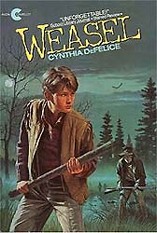
A continent and many years away from the Jean Little book, 180 degrees different in every way almost, Weasel is about a boy named Nathan and the hard history he comes up against. Set in the American woods soon after Daniel Boone's time, this story tells about Nathan's meeting with Ezra, a man who's lost everything, and Weasel, the man who has taken it from him for no reason but cruelty. Nathan encounters Weasel himself and is forced to examine his own notions of justice....

... And so is the reader.
There were several times in this book where I myself was wondering, what would I do if I were in Nathan's place? It's hard to say, and I'm still not sure. This book isn't stopping short of putting the difficult questions - and the difficult truths - out there.
A key question seems to be: what makes a man good, what makes a man bad? Nathan recognizes that the settlers vilify the Indians. He himself hates Weasel. Weasel, granted, has done terrible things. What does this make Nathan in regards to how he acts towards Weasel?
I'm still thinking... I feel I could write an essay about it someday.
A keenly-written, sometimes heart-wrenching book about one boy's meeting with cruelty - and his ultimately love-affirming response.

Age rec: A man's tongue is cut out and his pregnant wife killed. This isn't shown, and described in little more detail than I've just used, but on Amazon there were some people who disliked the book for that reason. There is, of course, no question about the immorality of such killings and cruelty. The whole book, though, is a pretty in-depth discussion about morality and choices. I would love to use it to teach a class sometime. I personally would say ages 9 or 10 and up, simply because the main point of the story is ethics and a younger child might not understand most of it.

Sunday, June 26, 2011

Bloodline Rising, by Katy Moran

I read some good reviews of this one, saw it on the shelf, and the rest took care of itself.

Book in a nutshell:
We have a mysterious first-person narrator, whose name we later learn is Cai. He calls himself the Ghost, and he is a thief in Constantinople. We learn slowly about his family, his life, his world - and then, through a jumble of catastrophes, he is taken on a slave ship to Dark Ages Britain. There he learns that there was a good deal more about his parents than they told him, and that his thieving talents may be due to a little more than natural caution...

I loved this book very much. I liked Cai - a very realistic person, not always sure what to do, not always positive what's the right thing. He second-guesses himself, regrets his past mistakes, and tries to do the best with where he ends up. I loved his ability to land on his feet wherever he found himself.

The front of the book calls this "a companion to Bloodline." I don't know much about Bloodline, but this is a strong enough tale on its own.
Can I also mention that I love the cover? I believe the scene is actually mentioned in the book, as well as being a symbolic sort of picture.

The plot is a little hard to follow at parts, and I advise people to try to keep track of who's who. Names get thrown around a good deal. I think it would have been easier if I knew more of the Dark Ages history Ms. Moran was alluding to... But it never made me stop reading, though I did have to go back and check who someone was.

This book is a bit of a mix-up, genre-wise: somewhat fantasy, somewhat political, somewhat just an adventure. There's a lot of Cai's introspection as well. I think it's YA, though I've seen it called MG: there's a lot of strong language, and violence at the end.

The writing style is cryingly beautiful in many places, and always skilled. Some quotes:

It is one of those nights when my city feels alive. The crowds surging through her streets are her blood, the jumble of buildings her ancient bones. It's quicker to go by the alleys, but I race up the Mese, anyway...

-----

But I will reach him first, and we'll get away - by sea, most likely. There's always some boatman willing to look the other way if the coin's enough. Oh, my beloved city. I cannot bear this; I cannot bear to see her, smell her, for the last time. I cannot bear to look on the lamplit windows, the shadows of the grapevines as they droop down from the rooftops to the streets, the great dome of Santa Sofia, mother of all churches. I am leaving the perfumiers' quarter, and the rich, rolling scent of rose oil, spikenard, cloves, ambergris, and lavender makes me want to weep because I am smelling it for the last time. Now I am running past a tavern, and the smash of broken cups, the roaring of drunken men, is my city's farewell song.

-------

One thing I know: I shall stay away from girl folk as long as I can. Trouble finds me quick enough as it is.

------

I gaze up at the skeins of fog silvered by the moon. It is full, round, and cold, so huge and far away, like a great silver dish. What a price she'd fetch if she were plucked from the night and sold. It is the same moon that shone on me when I was lord of the thieves, lord over the City of the Rising Moon.

---

I fondly love this book; I shall buy it someday, likely enough. I like books of non-circular traveling - I like books where the characters don't have infallible instincts - I like mysterious pasts slowly revealed. Also, I like covers that aren't a photograph of an odd-looking teenage female.

Is there a sequel? I'd be glad to travel with Cai for many a mile yet.

Age rec: Well, there's frequent swearing. A few mentions of nasty content, but nothing indecent shown onstage or anywhere near the stage. Very little romance, though there is a bit. I say 12 and up seems wise, though if parents give it a once-over they might try it with younger kids.

Tuesday, May 24, 2011

Time Travel Tuesday: De Camp's Lest Darkness Fall

Imagine you found yourself sixth-century-AD Italy. Your first question's probably, "What was happening there then?" Next would be, "How do I learn Latin or Gothic?" Those matters dealt with, you'd be faced with a bigger question: would you settle for staying alive and perhaps relatively comfortable in that era as the remnants of Roman culture are falling apart around you, or would you try to improve things?

L. Sprague de Camp, a very prominent fantasy author in his day, has his protagonist choose the second. In Lest Darkness Fall, Prof. Martin Padway — fortunately, an archaeologist who's been studying that very period and knows the languages — finding himself in that situation, tries to prevent the Dark Ages from falling across Europe.

Problems dog his every effort to build up technology. Does he want to change the world? Well, first, he needs quick money. So, build a modern brewery. Well, he needs copper plate pipe. The coppersmith is able to make it - but Padway needs to stand over him telling him how to do every step. And then he needs to pay the smith with money borrowed at ruinous interest rates. Once that's all done, he needs to keep the autocratic (if generally benevolent) Ostrogoth kings from destroying his business (which, by now, includes a burgeoning newspaper publishing the gradually-improving work of Padway's trainee journalists).

It shouldn't have been a surprise that Padway was eventually arrested. When you make such waves in an autocratic kingdom, while behaving in such an obviously foreign manner, something's going to happen eventually. Still, it shocked me — a sign of how de Camp's storytelling had drawn me into Padway's brave efforts. Our hero emerges from the prison camp resolved that, if he can't safely ignore politics, he's going to interfere in them as much as he can!

Shocking people with his accurate knowledge of then-future events, Padway wins his way to leadership. He then proceeds to totally upset the traditions of the Ostrogoth kingdom, free the slaves, train a corp of archers in preparation for the Byzantine attack he knows is coming, and - finally - [SPOILER: final outcome] win the war.

The beginning of this story felt painful to me, but only because of a misconception: I'd confused it with another time travel story where the protagonist roundly fails at everything he tries. Once I realized that de Camp doesn't mind having Padway succeed, I watched his adventures with pleasure. I didn't know much about metalworking, journalism, telegraphy, or Ostrogothic politics, but de Camp explains everything so we can see the challenges before Padway and share in his triumph at surmounting them.

All in all, this is an appealing story for mature readers about a man trying to improve a previous age. Padway's goals aren't perfect, of course. He's quite cynical about religion and private morality; one of his taglines is, "I'm a Presbyterian; that's the closest thing to" [whatever denomination/heresy his interlocutor professes]. His private life doesn't infect his plans, though. I'm sure we'll all approve of advancing science and preventing the Dark Ages.

Time Travel Tuesday is inspired by Charlotte's Library's regular "Time Slip Tuesday." Yes, Charlotte, there are good time travel novels, even if not many more are being published today.

Saturday, April 23, 2011

Mara, Daughter of the Nile by Eloise Jarvis McGraw

All credit to the discovery of this book goes to my mother, who read it to my brother and I when we were younger.

Historical fiction, as you've probably already learned from my blog, is not a genre I often get excited about. It's a wonderful genre and needs more good books, but what's in it now is not always that great.
By which same token, this book was originally published in 1953.

So what's it about?
Mara, Daughter of the Nile is about a revolutionary, and a revolution; about the Pharoah Hatshepsut who is not a good ruler, and the imprisoned Prince Thutmose who some believe could be. But it's also about Mara the slave-girl, brilliant and street-smart and tricky and proud and somehow utterly engaging. She is sold to an agent of the Pharoah and told to act as a spy for them, and then finds herself caught up in working for the other side, for the revolutionaries.
At first she intends to please her new master and turn the revolutionaries in... but the leader of the revolution is a young man named Sheftu, and Mara finds herself disliking the idea of causing his death...

This is an amazing book. Yes, it is a romance. But it's also an espionage story, a political story, a revolution story, a story set in the vivid and far-off world of Ancient Egypt. It's incredibly well-written and action-packed enough to satisfy anyone.
As one of my friends (Sylvia let's call her) said just a few days ago, "It looks like one of those books your parents give you for your education. But it's good!"

Some quotes:

...He gave Nekonkh a moment to absorb that thought, then added casually, "So you would overthrow the queen?"
"By the Feather of Truth, I said no such thing!" gasped Nekonkh. He darted an agonized glance up and down the deck, then strode to a deserted spot in the bows.
Sheftu followed, his face amused. "A wise precaution.... They say the queen's spies are everywhere."
"No doubt!" Nekonkh was convinced he was talking to one that minute.

--------

"Egypt is not pharoah, Mara, nor is it this long, green valley with its black mud that is so different from what I know. Egypt is neither the Nile nor the cities - "
"Then what is it?"
"You, Mara."
"I?"
"And all the others - the people, all those you have told me of, and the fishermen yonder on the river, and the potters and carpenters and their like... - and their friends, and their kin...."

-------
{Writing that last quote makes me want to cry because of a certain later part.}

Perhaps you've gathered by now how much I love this book. I think it should be on everyone's list. It does also make an excellent read-aloud.
Age recommendations: anyone old enough to appreciate a good thrilling plot. There's some kissing and some violence, but I was about nine years old when I read it, so I don't think it's a problem. People do swear by the Egyptian gods; I don't find that offensive, but some might. Parents worried by any moral ambiguity of the protagonist may relax in the fact that things do change by the end.
In fact, (highlight for hidden spoiler) Mara's final decision to keep her word and be selfless is what saves the day in the end. Don't think I'm a wimp, but I honestly find those parts near the end almost heartbreakingly wonderful.

What are you waiting for? Go forth and read.