Showing posts with label stellar. Show all posts

Monday, June 4, 2012

Taken by Storm, by Jennifer Lynn Barnes

A vivid, wrenching, entirely worthy conclusion to an excellent trilogy.


Take everything we've seen from Ms. Barnes before in this series and mark it up by fifty percent - the violence, the emotional impact, the shocking plot twists - then reduce the size of the book by a fourth, and you'll have this speed-reading terror of a foil-bound trilogy-closer. (I'm going to be speaking about it as though it's the end of the the series; it has a definite ring of finality to it that I hope goes undisturbed, and from what I've heard on the author's site, it will.)


If anyone's reading this and doesn't know the first two books... click on the "shapeshifters" tag and find my reviews of them. Here we have Bryn, the human girl raised by a werewolf pack after the murder of her parents... Bryn, who has by this book grown up a good deal and taken her own very unique place in her raw, wild, and dangerous world.

I'm saying very little here, to avoid spoilers. Because trust me, for this book, you don't want'm. I was on the metaphorical edge of my seat the whole time. Suffice to say that a long-held question of mine was answered, one of Evan's predictions came true that I didn't believe would, and one of my predictions did as well. Two plot points that we both expected also occurred. Not that I'm saying this book is predictable - I was eeping the whole while.

There will almost certainly be a few points at which you will beg, "Don't let it end like this!"
Almost certainly a few to the tune of, "Is there honestly a way out of this?"
Wordless exclamations are also not inappropriate at many spots.

I'm not entirely positive what I think of Callum's prescience as a plot device. It may have annoyed me... I'm honestly not sure whether it did or not. On the other hand, it annoys other characters, too.

For those of you who read Hunger Games, you'll probably come to notice that Ms. Barnes has jumped on the "surprise chapter endings" bandwagon. I'm not un-sorry. But I did have to cover a few endings with my hand because my nervous eye has a tendency to jump ahead of my reading.

(I just turned on Handel's "Messiah" again. I think I did this writing the review of the first book, too. I detect a trend here?)

Age rec: This is going to stop all of nobody, but probably fifteen and up? And up? (chuckles nervously) Just for violence and some slightly disturbing scenes related to same. Unlike the previous two books, I found some parts of this one uncomfortable. Trust me - not because of the romance, so for any of you who worried that the third book would involve flagrant indecency, lay your minds at rest. [I am about to slightly qualify that last statement with a very indefinite and small spoiler that avoids naming names: One of the characters becomes pregnant while unmarried, but the fact alone is established onstage, without any indecent content in sight.]

Bottom line: The promise held out in the first two books is amply fulfilled and then some.

Thursday, February 2, 2012

Two new MG/YA releases I read this week

Both of these books are fresh, new, well-written additions to the MG/YA shelves. I highly recommend the two of them.

----


Cinder
, by Marissa Meyer

I have my friend to thank for lending me this one... the same friend who convinced me to read The Perilous Gard, so you see I owe her a lot.
Cinder is ... a sci-fi retelling of Cinderella, set in New Beijing, far into the future. There's a Lunar colony (with a mind-controlling ruler), a bunch of neat technology, a lightly-written romance, a terrificly sad event that I still am trying to figure out how the plot could have worked without, and a mint of good writing.
Plus, the Cinderella character is a cyborg. Yes, I said a cyborg. And the whole thing works, yes, it works! Even though I guessed one of the twists, I didn't care. There were others I didn't. Also, I appreciated the Chinese culture references throughout the book. Though I've nothing against most of the futuristic novels out there, they seem to focus on the United States, and it was refreshing to see a different setting and society. One plot point seemed a little weak to me, but that's the only objection I could think of.
There's lots to love in this book.
Even though if you carry the book around without the dustjacket, you may get asked about the "Meyer" in metallic red type on the spine... (Had to explain to a pal of mine, no, not THAT Meyer!)

Age rec: Really, this could be MG. I can't recall anything that would stop me from giving it to a middle-schooler... no mature content, not even any swearing that I remember. The only problem would be some rather chilling descriptions of the letumosis plague hospital - and, of course, the nasty behavior of a few characters.

--------

Winterling, by Sarah Prineas

I got this one for fun from the local library. I'd read enough reviews to believe there was nothing really amazing on the plot front, but I'm glad I picked it up anyway. I was surprised at how much I enjoyed it!

It's nothing too amazing on the surface... girl discovers her parents belonged to another world, finds gateway, enters, has adventures... but Sarah Prineas weaves the loveliest story together. The elements may sound cliched - an evil Lady who must be defeated, a land bound in winter, a tricky shapeshifter boy as companion to the heroine - but don't be deceived. Winterling is far more than the sum of its parts.

There's the imagery of the "dying crown" of leaves, of Fer's jacket, of the black feathers; the swift poetry of the Hunt's ride through the night; the strict rules of the land involving threes and oaths and bindings; the herbal magic, concrete and yet symbolic at the same time. The writing is simple and flowing.
For all that I thought the plot sounded cliched at first - its individual parts were not, though the main concept was... familiar. Yes, that's the word for Winterling: "familiar." But in a good way, like N. D. Wilson's Dandelion Fire felt familiar. Stories like that can be retold because they work.
And I haven't even gotten into all the neat stuff that makes this book special - the landscape descriptions, the moon reflection in the water, the subtle humor spread throughout - and the wolf guards! Those wolf guards! ...Words fail me.

Age rec: I would say MG and up. Nothing I can recall that would give any trouble.

Sunday, November 13, 2011

Matched, by Ally Condie


How I found this book: Picked it up because I'd also just picked up Divergent by Veronica Roth, both of which being rec's from a friend of mine.

(Picture found on the author's website.)

I'm going to leave off the proper plot summary because it's really not the best part of the book - in fact, it could turn off some people who are tired of love triangles, enough so that they miss a really fine novel.

You may have heard that this book is a "rip-off of The Giver." I did certainly notice some similarities... For people who've read The Giver as their "first dystopia" just like I did, it's a little familiar. But then it's also very different. It's a teen vision, a girl's vision.

The world of Cassia's Society is almost a utopia - until one thinks about it. It's peaceful, beautiful, safe. No one has to worry about choices - or choosing wrong. Nearly all disease is gone, nearly all accidents. The food is perfectly portioned, the schedule of each person detailed, by the Officials. There's no obvious show of force or coercion. Even death is made a quiet, formal thing, when each citizen dies peacefully at precisely 80 years of age. 100 poems, 100 songs, 100 works of art are there - selected by the creators of the Society. There's no fear and no change.

Cassia's personal view of her quiet, pretty world changes twice in quick succession. First, when her "Match" - the person she's later going to be married to - turns out to be her friend Xander... but then a picture of another boy appears briefly inside the "match" information package. An Official assures her that this is merely a mistake, and that the boy whose picture she briefly saw is not even allowed to be Matched, as he is an Aberration. But he's also a boy who she's met before. Second, her grandfather turns 80 and dies painlessly as is usual in the Society - but he shows her a gift that ought not to even exist... a piece of paper with two poems that were not within the 100.

It's more than a "love triangle" when Cassia finds herself liking Ky - the Aberration - as well as Xander. It's a choice she's wavering in - between the simple childhood friend, the one she views as the Society's choice for her, and the odd boy who teaches her how to write her name and shows her the poems that he makes up. And she has allies in this "rebellion" that she chooses to make - the memory of her grandfather, and one of the poems that he gave her: Dylan Thomas's Do Not Go Gentle into That Good Night.

(I used to not like that poem, but now I do a good deal more. Perhaps whenever I read it, I will have a little mental picture of a girl in a green dress, holding a glint of gold in her hand.)

Cassia's not a brave revolutionary. She burns poems out of fear - but she loves the words that she feels driven to destroy. But she knows in the end what choices to make - and she is brave - tremendously brave.

I like that this book honors the connection between individuals. Cassia confides in her family members, and they in her. She loved her grandfather and honors his memory. She speaks the truth to Xander about her feelings for Ky, saying before she does - "I could love him. I do love him. And because I do, I have to tell him about Ky. I do not mind stealing from the Society. But I will not steal from Xander any longer. Even if it hurts, I have to tell him. Because either way, whichever life I build, has to be built on truth."

I had to include that last quote. It's one of the best lines I've read for a long time in a YA book. And, in a way, it captures what I see as the essential inside message of Matched - that life has to be built on truth, not just fact but truth.

---

It would be a quick step from there to speaking of the Truth Himself - a step that the Ms. Condie, however, doesn't choose to take. But for a modern YA dystopia novel - this one is on par with The Hunger Games as the most relevant, truth-filled one I've read yet.

In my opinion, the most chilling scene of the whole book is near the beginning. Cassia's father works on collecting artifacts for the Officials to review. Cassia goes to his worksite at one point. They're excavating an old library.

"The workers...suck up piles of papers with the incineration tubes. My father told us that right when they thought they had gone through everything, they found steel boxes of books buried down in the basement. Almost as though someone tried to hide and preserve the books against the future. My father and the other Restoration specialists have been through the boxes...they will incinerate all of it."

"...There are few piles of books left...the workers move from one to another... It's faster to incinerate individual pages instead of books, so they slice the books open, gutting them along the spines, preparing them for the tubes."
"...The books' backs are broken; their bones, thin and delicate, fall out. The workers shove them toward the incineration tube; they step on them. The bones crackle under their boots like leaves..."

Shudder.

Ms. Condie is an English teacher, according to her bio. I know that to her as well as to me, this is a terrible image.

---

Age rec - This could almost be upper MG and up. There's no swearing, nothing more than kissing in the romance. But, as in all dystopia novels, the premise is a good bit disturbing.
For ages 14 and up - go for it!
Especially rec'd for those who aren't quite up for the violence and emotion of The Hunger Games but want to read a wisely-handled novel of this sort.

Sunday, October 23, 2011

The Scorpio Races by Maggie Stiefvater


How I found this book:
I detested the beginning of Shiver but remembered the odd name of the author; when I saw this book on the New Teen Books display at the library, I scanned it (must have been only the back cover excerpt?) and brought it home in one of the most trusting book-obtaining sprees I have ever gone on. I don't know what got into me, really. But this time it worked...

To be open and up-front with you, readers, I am 100% wowed with this book. I am buying myself a copy. I may also get horseback riding lessons. Who knows?

And I love the cover, too.

Book in a nutshell:

The island of Thisby (apparently supposed to be somewhere off the English or Irish coast) has one unique thing, one terrible and beautiful thing that sets it apart. It has the capaill uisce, the water horses, that come out of the sea in late autumn - the horses who eat meat, who kill humans, and who run like the wind.
The Scorpio Races is a yearly event on the first of November. In the month before, as the capaill uisce come up, people begin to train and ready for it. But this isn't a horse race. This is a water horse race, along the beach, fighting to control your magical mount and not be attacked by anybody else's on the way.
This is the story of two competitors: Puck Conolly, a stubborn girl hoping to win the race so as to earn money to save her family's home, and Sean Kendrick, a young man who rides a capaill uisce that belongs to him in all but lawful contract. The stakes are high, and the training season is beginning.

---

The Scorpio Races is a heartwrenching, beautiful, fast-paced book with just the right amount of everything. It's for horse-lovers and fantasy-lovers and action-lovers - if you're looking for just a romance, there's one here, too, though it's pretty subtle compared to many out there.

This is a very well-written book. Ms. Stiefvater doesn't waste words, but she scatters them well; the Festival scenes were especially well-done. Though the dual-narrators thing occasionally left me confused as to who the "I" was at a given point, I didn't count points off. It was a good way of telling the story - in fact, the best that I could think of.

The capaill uisce (Author's Note assures us it's pronounced CAPple ISHka) especially resonated with me, as I have a peculiar mix of love/fear feelings toward horses. I never had too much experience with them, and I doubt I'll ever lose my slight wariness when around them. Even though these are fantasy horses, I felt that I could transfer some of the characters' feelings to apply to real-life horses: respect, admiration, excitement, sometimes love, occasionally a degree of trust, an understanding of the power of the animal and the potential harm they can inflict. (If you are a horse lover, please understand I do not mean to insult domestic horses. I've met many lovely horses in my life and know that most of them are perfectly friendly. But I respect them, their size, and their occasional unpredictable behavior.)

It's a story about losing things, or being on the brink of losing them, or considering whether you have them at all. Puck's brother Gabe wants to leave his orphaned brother and sister and go to the mainland. Sean wants his own life, outside of the stable where he's been working for nine years, and most especially wants to own his capaill uisce Corr for himself. Puck wants to keep her life together and not lose the house - or her brother Gabe. Odious Mutt Malvern wants something... the lovable Dory Maud and her sisters want something... Some wishes are possible, some seem impossible. Some are granted, some not.

Another interesting theme is Puck herself. She's not only the first girl to run in the Scorpio Races, but also... an atypical entrant in other ways (avoiding spoilers here). She undergoes all kinds of attempts to get her to withdraw her entry, attempts made by people with reasons ranging from tradition to sheer meanness. And when she's asked at one point whether she was "inspired by the women's suffrage movement," she answers, "I'm just a person with a horse, same as anyone else on this island." True. I don't see Puck as a feminist. She's not trying to be revolutionary; she's just being herself.

I also noticed a strong thread about home and belonging. Sean dreams of having his own farm. Puck wants to keep living in the house with her brothers. They belong on Thisby - they belong to Thisby. But others - such as Gabe and his friends - speak of not being able to stand the island, of wanting to leave. And then there are the tourists, including George Holly, who love Thisby but only for as long as the exciting races are going on.

I could hardly put this book down. Nearly every suspicion and guess I had about plot outcomes was disproven. Ms. Stiefvater made a bright, dangerous, living little world that I'm sorry to leave, even though I half-imagine it's going on still while I have my back turned! My heart went out to many of the characters. For a moment I even felt sorry for Mutt. But this is a book of hope, as well as loss, and the last page brought tears (of joy) to my eyes. (Yes. Rina, who didn't cry during any of the Hunger Games books, cried at the ending of The Scorpio Races. Finish it, and you'll see why to.)

Age rec: I'd say 13, 14 and up. There are some references to things, but nothing I considered terribly embarrassing - a little swearing, too - and the romance is surprisingly light (esp. considering what I've heard of the author's previous work). The worst that can be expected are the rude insults and ragging that Puck receives as persecution from hostile islanders. I can definitely recommend this book for boys and for girls, for teens and for grownups.

Tuesday, September 13, 2011

Two very beautiful MG novels

A double post today! Both of these came from my library, when I was browsing the younger section for something pleasant.

Dancing Through the Snow, by Jean Little

This is the story of Min: early memories of a callous, abusive pair who weren't her parents, abandoned in a public place, in and out of foster homes for years. Now, a little while before Christmas, she's been returned to the social services office again after another placement that didn't work out. But a new chance comes, in the form of Jess Hart, a doctor who helped her when she was younger. Jess, with a characteristic disregard of red tape, sweeps Min away to her own home. And this begins a new life for Min - full of unexpected complications, like an abandoned dog, a puppy-mill investigation, and an irritating boy named Toby, as well as with surprising joys.

At its heart this is a simple, gentle book about a girl finding her place in the world. Each of the characters is lifelike, from caring Jess Hart to even the difficult Toby. There's no earth-shaking conflict or excitement in this book, but there's all sorts of beauty, and the small decisions of right and wrong, good and bad. I felt that this book could really have happened - and stories like it probably have, before.

Age rec: anyone. The more unpleasant aspects - Min's difficult early life, the puppy mill - are, if not ignored, "lightened" for younger readers. And I myself was moved almost to tears at several points, including the ending.


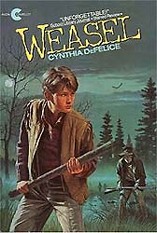
Weasel, by Cynthia Defelice

A continent and many years away from the Jean Little book, 180 degrees different in every way almost, Weasel is about a boy named Nathan and the hard history he comes up against. Set in the American woods soon after Daniel Boone's time, this story tells about Nathan's meeting with Ezra, a man who's lost everything, and Weasel, the man who has taken it from him for no reason but cruelty. Nathan encounters Weasel himself and is forced to examine his own notions of justice....

... And so is the reader.
There were several times in this book where I myself was wondering, what would I do if I were in Nathan's place? It's hard to say, and I'm still not sure. This book isn't stopping short of putting the difficult questions - and the difficult truths - out there.
A key question seems to be: what makes a man good, what makes a man bad? Nathan recognizes that the settlers vilify the Indians. He himself hates Weasel. Weasel, granted, has done terrible things. What does this make Nathan in regards to how he acts towards Weasel?
I'm still thinking... I feel I could write an essay about it someday.
A keenly-written, sometimes heart-wrenching book about one boy's meeting with cruelty - and his ultimately love-affirming response.

Age rec: A man's tongue is cut out and his pregnant wife killed. This isn't shown, and described in little more detail than I've just used, but on Amazon there were some people who disliked the book for that reason. There is, of course, no question about the immorality of such killings and cruelty. The whole book, though, is a pretty in-depth discussion about morality and choices. I would love to use it to teach a class sometime. I personally would say ages 9 or 10 and up, simply because the main point of the story is ethics and a younger child might not understand most of it.

Tuesday, August 16, 2011

Top Ten Tuesday - Freebie week: Top Ten Striking Books

Top Ten Tuesday is hosted by The Broke and the Bookish; thanks to them for hosting, and thanks to The Secret Adventures of WriterGirl for joining in and bringing this to my notice. I'm happy to present my first - and on such a nice Tuesday!

Top Ten: Freebie

Rina's Top Ten Striking Books

Striking, n.: in this case, unique, unexpectedly beautiful, and with long-lasting echoes.

Come on, I'm sure we've all had at least one - that book you pick up and start reading, maybe with high hopes, maybe with none. And all of a sudden a creeping sensation comes over you saying, this is a good book. This is a really good book. This is a really, really good book. This is a book that I've never seen anything quite like before.

Without further ado (and in no particular order of strikingness):

1. The Lord of the Rings, by J. R. R. Tolkien
Okay, perhaps there is an order to this list.
My dad and brother were discussing Tolkien's literature while I was at my formative language stage - I'm surprised I'm not bilingual in Elvish as a result. I had these books read to me when I was eleven.I don't know what I'd been expecting, but it hadn't been what I found.
Bear in mind that my only fantasy novels before then were the Redwall books and the Chronicles of Narnia. I was floored. That any thing of paper and ink could contain the characters, the world, the choices, the magic, the sheer volume that The Lord of the Rings did - no wonder I turned into a fantasy writer that year.

2. Incarceron, by Catherine Fisher
This is a pretty recent read. I heard it on audiobook, actually, and I wish I could personally thank Kim Mai Guest for her beautiful narration. Ms. Fisher has spun not one but two worlds in this book, and she's brought them both to bright, breathtaking life.
From the mighty halls of Incarceron, tangled with darkness and mechanical rats; to the soaring point of Blaize's tower, its airy room full of glass globes; to the summer days and carefully-arranged diorama of Protocol - we carry our own crystal Keys along with the characters, peering into their brilliant worlds.
And the breakneck pace of the action hardly drops for a moment. If there was any part of the story that dragged, I didn't notice.
Ms. Fisher has dressed up a dystopian novel as high fantasy, created worlds clear enough to dream into, and managed to write two stunning books with hardly a crumb of romance - someone give her a medal.

3. By These Ten Bones, by Clare B. Dunkle
Part of the wow of this book, I thought in the beginning, was my chosen place/time to read it: the dark backseat of a car heading south to Georgia by night, with a small booklamp shining cold on the pages and Michael Card music playing in the background. But two years later, I've read it in front rooms at church retreats and curled up at the foot of my bed, and I still love it. (Though I would also love to "fix up" a few of the dialogue tags.)
Part of the greatness of this book, I think sometimes, was that it was the first werewolf novel I'd ever read. Now I've read a few more, and heard just about every possible twist on the topic, and I still hold onto this little book as my favorite. (Though I'm nothing loth for a little Jennifer Lynn Barnes on occasion.)
It is written by a Christian author, and is a Christian book, though not of the bland, didactic (or badly-written and barely moral) sort all too often fobbed off on us Christians who only want a little decent adventure.
Since it's so many things, I take it for what it is: a short, dark gem of a tale. A book about a werewolf boy and the plain, ordinary Scottish girl who makes up her mind to save him. A book that prickles up the back of the neck sometimes. A book that speaks, in simple words, of olden-days Scotland and its people, as well as of courage and fear and love and sacrifice. A book that descends almost into hopelessness and ends in - well, that would be telling, wouldn't it?
Go read for yourself. It won't take but a few hours.

4. Uncle Tom's Cabin, by Harriet Beecher Stowe
Mark Twain is credited as saying, "A classic is a book that everyone wants to have read and no one wants to read." Sadly, this book has been placed on that selfsame shelf. True, some of the words may be a little odd to us today; true, the beginning is slow and the tying-up-all-the-threads ending slower; true, we may become tired of the author's intrusions on the narration to highlight a point.
But this isn't the ordinary historical fiction, written when the sins of the past are viewed in 20/20 hindsight. This was written in the very days it describes, by a woman who refused to be silent about the atrocities many in her society accepted as normal. For that, if nothing else, it deserves our attention.
And - I'm afraid this'll be more convincing - it's just a really good book!

-----
(All right, I did give the four best the four first spots. But these other ones are striking, too.)
-----

5. The Great and Terrible Quest, by Margaret Lovett
An old book, both in terms of publishing dates and in how long it's been since I first read it. Back in the day when my mom read books to my brother and me, this was one of my brother's choices. I was skeptical: this was when I preferred animal stories over people stories.
Was I ever surprised!
It's a story of Kings and Lords, of a sort-of Medieval Europe place, of an orphan boy and the forgetful, odd man that he chooses to help - and follows into fear and wonder and a life he's never expected. As a children's book it's unbelievably good; as an adult book it's still amazing.
And, for my animal-loving younger self, there was even a clever jester's dog around.

6. Reaching Dustin, by Vicki Grove
A random library acquisition turned out to be something very special. Local library sadly doesn't seem to be able to locate their copy anymore, so I haven't read it in longer than I'd like. It's about a writer girl (understandably a favorite topic of mine), but so much more than that - it's about acceptance, and reaching out, and long-lasting effects of actions. I love Ms. Grove's mythological references, her beautiful writing style, the leit-motifs of stories and songs and retribution, and a particular set-up of words near the end of the book. I love, also, these books where the past and the future meet in one place, and we watch our handful of characters turn one into the other.
I really need to see if the library has found it yet.

7. The Queen's Thief series, by Megan Whalen Turner
I read spoilers for this series, positive that I wouldn't ever read it. A disappointing blurb in the library brochure, not to mention my irrational wariness of Greek or Roman-ish books (maybe I thought they would be like the Greek Myths?), didn't draw me to book 1 at all. But somehow I picked up The Thief anyhow.
Four books into the series, I'm entirely sold. The humor! The unreliable narration! The slightly-spun classical myths! The characters... Tricky Gen. Gallant Eddis. Poor, savage, trapped Attolia. Earnest, shy Sophos. That poor magus who puts up with so much. And those infuriating Mede ambassadors! I don't think I could live in these books - I'm not half clever enough - but I joy to read them.
How I long for the next in the series. Two books more - but how many years?

8. A City in Winter, by Mark Helprin
At first it looks like a picture book. And yes, it does have beautiful painted illustrations every six or ten pages, large type, and glossy pages. But, though I know some eight-year-olds I'd give it to, there's nothing juvenile about this book - even less about its sequel The Veil of Snows. This story of a lost princess and her quest to overthrow the evil usurper is at the same time completely serious and entirely absurd. I might cry, if I weren't so close to laughing; I might laugh, if I weren't so close to crying. All of this makes it sound insane, or else makes me sound insane.
But if you read it with the faith of a child, maybe you'll understand what I mean, too.

9. Dandelion Fire, by N. D. Wilson
This is an odd entry on the list, since it's the second book of a trilogy. The first, 100 Cupboards, is decently interesting, if a little odd in parts: a wimpy boy in Kansas discovers world-gate cupboards in the attic wall of his cousins' house. Not fantastic, but a good book. So when I discovered (at long last) that there was another, I decided to try it out.
Suddenly the black and green of the first book blossoms like a bursting dandelion into the blue and gold of its sequel. The magic reaches through the ordinary and sparks a story full of laughter and love and wonder and danger. The cupboard doors spring open (sometimes literally). A great power is threatening the worlds, and "all who can stand soon shall" against it. And we watch the brave ones fighting bravely - and the cowards becoming brave, and the fools wise. All in N. D. Wilson's deceptively bare prose, acted out on his briefly and vividly described settings.
Somewhere in Heaven, I think, might feel like Badon Hill.

10. Tales of the Resistance, by David and Karen Mains
Time runs short, but then I don't know what to say about this book really. My brother persuaded me to get it from the church library. I didn't have high hopes. But it's the oddest, strangest, loveliest children's allegory I've read since Narnia - and with beautiful pictures, too.

Saturday, August 13, 2011

Cart and Cwidder, by Diana Wynne Jones

I found this book because, in memoriam sort of, I am now reading more Diana Wynne Jones than I used to. And this looked to be a likely thing.

Book in a nutshell:
Moril's family are travelling entertainers - players and bards. We learn practically on the first page that the country they live in is divided into two rather sharp-edged sections: North and South. The North is a hazy dream beyond the mountains, the South an unpleasant reality where speech and song are censored and the lords of the land can basically do whatever they want.
But while Moril and his family are traveling up and down the South, they pick up a passenger: an annoying, mysterious boy named Kialan. His arrival begins a startling chain of events. After death, desertion, and the authorities are done with them, the traveling cart family has shrunk to only three members. And they know that their only hope is to get North.

This is a simple, straightforward book, a quiet and heartfelt story of family and friends and freedom, twined about with a love for song and words. I never guessed any of the surprises, though, for all its outward simplicity. Each of the people is carefully and almost invisibly characterized - even the musical instruments seem to take part in the story.

Honestly, there's not much I can say about it. All the wonder's in the book itself - it doesn't sound like much to say I love sweet, shy Dagner the composer, or feel sorry for Kialan's rather clumsy attempts to make himself friendly, or thrill at Moril's song at the climax. But it's a book that I can recommend to nearly anyone.

The only thing I could ask for improvement in is the songs - some of them might be a little more, oh, songlike? But that's a picky detail. And besides - I like reading about travelling players. They're a favorite of mine.

Especially when they're also revolutionaries.


Age rec: Anybody. Though it's rather sad at parts, I can't think of a single reason it should be kept away from anyone old enough to hear a good story. Diana Wynne Jones was pretty dependable on for that, with sole exception of the slightly disturbing elements in Hexwood (but that's another story and another post).

Who'd be interested in a Diana Wynne Jones blogweek?

Tuesday, July 26, 2011

More Not-a-Bookness, with cute dragons


Last night I watched How To Train Your Dragon.

I think it's one of my favorite recent movies... if not my absolute favorite, since I can't think of any I like better. The plot is pretty easy to anyone who's read any animal stories at all - but there's a lot to be said for this movie.

1. I liked the father-son relationship between Stoick and Hiccup. They're two good people who don't see eye-t0-eye about just about anything, and both of them are trying so hard to get along with each other. It's really a hard decision for Hiccup to make, choosing whether to kill a dragon or lose his father's approval. And I think that it hurts him at least as much to be rejected by his father as to have Toothless taken away from him.

2. There's a really strong plotline here about teamwork even if you don't like the other members of your team. Hiccup's teased mercilessly at first by the other teens, and even up till the end I can't see them really liking him, but when it's time for action, he recognizes his need for their help and brings them into battle with him. Also, there's the whole thing with people/dragon cooperation - yes, they're big, yes, they're different, yes, they've done things to us in the past, but no, we're not going to judge every one of them by what some of them have done.

3. The movie is awesomely done, the voice acting and the animation and the clever voice-overs at the beginning and end. "Some people have flies. Some people have mosquitoes. We have... dragons."
Astrid was convinced by one ride on Toothless, and I was too. I came away wanting to fly with them, through the sunset clouds and the Northern lights, on the back of a little dragon of my own... Who knows? Maybe someday between time and eternity I will.

Anyhow, go forth and try to watch this movie. I don't know if I rec it for very young children, as there's action at the end that is very vivid and thrilling even for me... but for anyone old enough not to be scared too much, it's a sweet, exciting, and heartwarming journey alongside this boy and his dragon.

Tuesday, July 12, 2011

Trial by Fire, by Jennifer Lynn Barnes

How did I get this book? Well, there's a bit of a story, actually. You who read the blog know how much I love Raised By Wolves. So I was going nuts over trying to get this one when it came out. I mean, more Bryn & Company? I'm definitely interested.
The library I normally use hadn't ordered it. The library I also have access to was ordering a copy and taking forever to get it. Then my friend (this one we'll call Dragonrider) came to my birthday get-together, bearing gifts...
... including Raised By Wolves and this book. Yay Dragonrider!
I stayed up way too late last night reading it.

Those who haven't read the first book, read my review of that. Then go read the book.

For those who have...

First round in "Bryn vs the werewolf Senate and tradition" is finished. The score: Bryn 1, Tradition 0.
Now she's the young, female, and human alpha of a very unlikely collection of werewolves. But they're Pack, and they matter to each other, and they don't mind being unusual. But now, scant months since the Cedar Ridge pack's formation, trouble appears... or rather, trouble collapses on the front porch on Thanksgiving night, and of course Bryn's not going to leave well enough alone.
Shay, the leader of the Snake Bend pack (and Devon's older brother) has gone too far with one of his pack. Now Lucas, injured and desperate, demands the protection of Cedar Ridge. At first it seems just an issue of a runaway Were, but when Bryn's nightmares worsen and the enemies begin to show up, it's clear that something more is going on. Something bigger. Something that's been brewing for a long while.
And the Cedar Ridge pack is right in the middle, headed towards battle and potential destruction.

If anything, I'm going to say, this is better than the first book. Jennifer Lynn Barnes is packing on the emotional impact, upping the stakes, introducing new threats. This book is about werewolves, yes, but it's also about responsibility, compassion... all the costs and benefits of being selfless, both to one's-self and to others around.
Bryn's done a lot of growing, and she's had to. She's still got her sense of humor, her friendly teasing, but she's an Alpha now, a leader. She's making decisions - decisions on how much to follow in Callum's footsteps, decisions at each moment about how much to enforce her authority on the Weres in her pack. At the beginning of the book she's been choosing leniency most of all, but as things heat up, her policies begin to shift around.

It's come to me that there's a huge theme-thread about authority in this book: how much does a leader have the right to control their people? Granted, in the real world we don't have psychic powers or pack-bonds to enact our will on others, but the question is the same. Where is the fine line, Ms. Barnes seems to ask, between suggestion and coercion, between influence and absolute control?
Even Bryn's attempts to use her Alpha authority can't stop some of the things that happen by the end of this book.

Every time I thought the plot was resting at last, something else happened, and I was on the metaphorical edge of my seat for most of it. Some of the scenes near the end are nearing literary greatness. The final one is simply, beautifully chilling. And I am heartened by the fact that there's already a rough draft of book 3 in the works!
Though those of you who reach the end of Trial by Fire will see a particularly hard scene coming up in that selfsame book 3. I know it will have to happen sometime, but that won't make it easy, for me or for Bryn or for a lot of others.

As for the romance... frankly, it's a little overshadowed by the fact that Bryn just has friends. Chase is simply another of them - another who perhaps views her slightly differently - and there's a bit of kissing but not much more.
(There is a point where I got nervous that they would go further, but though the book's vague about it, I'm positive they didn't. I wouldn't recommend some of Bryn's practices with Chase [technically I suppose he could pass it off as guard duty?]; however, nothing indecent actually occurs.)
In addition to that, there's another small romance that develops. Suffice to say that it doesn't lead to anything objectionable either.

This one has more of a bittersweet ending than the previous book. I hope this trend won't continue.... I love my Cedar Ridge people!

Age rec: Anyone who's read Raised by Wolves can read this with no problems. Though, as I said, Bryn does some things with Chase that I wouldn't recommend or practice, nothing objectionable happens. The violence is probably a little less present, except as follows Lucas... okay, skip what I said about less violence. These books will be violent at times; that's just how they are. And I don't think any less of them for it.

Sunday, June 26, 2011

Bloodline Rising, by Katy Moran

I read some good reviews of this one, saw it on the shelf, and the rest took care of itself.

Book in a nutshell:
We have a mysterious first-person narrator, whose name we later learn is Cai. He calls himself the Ghost, and he is a thief in Constantinople. We learn slowly about his family, his life, his world - and then, through a jumble of catastrophes, he is taken on a slave ship to Dark Ages Britain. There he learns that there was a good deal more about his parents than they told him, and that his thieving talents may be due to a little more than natural caution...

I loved this book very much. I liked Cai - a very realistic person, not always sure what to do, not always positive what's the right thing. He second-guesses himself, regrets his past mistakes, and tries to do the best with where he ends up. I loved his ability to land on his feet wherever he found himself.

The front of the book calls this "a companion to Bloodline." I don't know much about Bloodline, but this is a strong enough tale on its own.
Can I also mention that I love the cover? I believe the scene is actually mentioned in the book, as well as being a symbolic sort of picture.

The plot is a little hard to follow at parts, and I advise people to try to keep track of who's who. Names get thrown around a good deal. I think it would have been easier if I knew more of the Dark Ages history Ms. Moran was alluding to... But it never made me stop reading, though I did have to go back and check who someone was.

This book is a bit of a mix-up, genre-wise: somewhat fantasy, somewhat political, somewhat just an adventure. There's a lot of Cai's introspection as well. I think it's YA, though I've seen it called MG: there's a lot of strong language, and violence at the end.

The writing style is cryingly beautiful in many places, and always skilled. Some quotes:

It is one of those nights when my city feels alive. The crowds surging through her streets are her blood, the jumble of buildings her ancient bones. It's quicker to go by the alleys, but I race up the Mese, anyway...

-----

But I will reach him first, and we'll get away - by sea, most likely. There's always some boatman willing to look the other way if the coin's enough. Oh, my beloved city. I cannot bear this; I cannot bear to see her, smell her, for the last time. I cannot bear to look on the lamplit windows, the shadows of the grapevines as they droop down from the rooftops to the streets, the great dome of Santa Sofia, mother of all churches. I am leaving the perfumiers' quarter, and the rich, rolling scent of rose oil, spikenard, cloves, ambergris, and lavender makes me want to weep because I am smelling it for the last time. Now I am running past a tavern, and the smash of broken cups, the roaring of drunken men, is my city's farewell song.

-------

One thing I know: I shall stay away from girl folk as long as I can. Trouble finds me quick enough as it is.

------

I gaze up at the skeins of fog silvered by the moon. It is full, round, and cold, so huge and far away, like a great silver dish. What a price she'd fetch if she were plucked from the night and sold. It is the same moon that shone on me when I was lord of the thieves, lord over the City of the Rising Moon.

---

I fondly love this book; I shall buy it someday, likely enough. I like books of non-circular traveling - I like books where the characters don't have infallible instincts - I like mysterious pasts slowly revealed. Also, I like covers that aren't a photograph of an odd-looking teenage female.

Is there a sequel? I'd be glad to travel with Cai for many a mile yet.

Age rec: Well, there's frequent swearing. A few mentions of nasty content, but nothing indecent shown onstage or anywhere near the stage. Very little romance, though there is a bit. I say 12 and up seems wise, though if parents give it a once-over they might try it with younger kids.

Monday, June 6, 2011

Raised by Wolves, by Jennifer Lynn Barnes

How I found this book: I heard good things about it from bloggers before it came into my library. When I saw it on the shelf, I thought, well, let's give it a try... I can send it back if I don't like it.
The first page had me hooked.

Book in a nutshell: Bryn (full name Bronwen Alessia St. Vincent Clare) has been adopted by the local werewolf pack after a loner werewolf killed her parents. She remains fully human and very independent, however. When she begins to have her priviledges curtailed and obscure warnings issued, she guesses that something is up.... something the werewolves don't want her to know about.
Discovery upon discovery will lead her through pain and trouble and rebellion, far into the wilderness, and finally to a final confrontation with the truly chilling villain who is responsible for her parents' deaths - and for much, much more.

This was a new sort of tale for me... I usually thought werewolves were the Antagonists, or at any rate that They Ought To Be Avoided... I think it was my violent mental allergy to most paranormal books that kept me in that mindset. My earliest book on the subject formed my opinions, and they stacked up to Keep A Long Way Away From The Werewolf. So when I found this book, I had to suspend my previous feelings. Fortunately it wasn't too hard, as even Bryn still finds her "packmates" scary.

Some traditions hold, as well as the "scary" part. As in, werewolves still have an allergy to silver. But Ms. Barnes manages to mix the elements quite nicely, and I think most readers will find her 'wolves a fair cross between the original legends and the um, new urban edition.

(Unrelated subject: Just turned on a CD of Handel's Messiah. Terrific music. The opening symphonia is pure heavenly sound... I adore violins!)

Raised by Wolves is not a paranormal romance - thank heavens. Sure, there is a romance going on. But it is not the focus of the plot. It's more of a thriller... that just happens to be about werewolves.... really.
And Bryn is such an extremely sensible person, she doesn't allow herself to dissolve over a guy. She questions their connection and defends it on other than romantic grounds. And I must say, the Signifigant Other is a strong and intelligent person on his own.

The antagonist of this book is about the scariest villain I have read about since the Nazgul. Just saying.

Some quotes:

"I really don't know why you're here," I told him, selecting my words carefully. Most Weres could smell a lie, and Callum, the alpha of alphas in our corner of the world, would have known immediately... Luckily for me, I didn't know precisely what it was that I'd done to merit a visit from our pack's leader. There were any number of possibilities, none of whcih I wanted to openly admit to on the off chance that there was something I'd done that he hadn't found out about yet.

-----------

There were several streams in the woods, as well as the disturbingly named Dead Man's Creek...

--------

...I knew I shouldn't respond, knew that anyone in Callum's basement was there for a reason... Whoever was down there sounded like I felt. It didn't matter who it was or what he'd done. I had to help him, because it wasn't like I could do a thing for myself...

--------

"You've never brought her back irreparably harmed," Ali admitted grudgingly. "This better not be a first."

-------


And by the way, I am quite delighted with the delicate power-balances of werewolf politics. This has got to be the only paranormal book where a character asks "Is this a democracy or isn't it?" and the answer actually matters. I can tell that Ms. Barnes put not only her heart into this writing, but also her mind.

As I told my brother not too long ago, "I could live in this book's world. I really could. And I can't say that for many books."
Though I did have to add, "Of course, I would probably have to break my habit of indiscriminate night wandering..."

Age rec: Thirteen the absolute rock-bottom limit. It's not for any indecency... the romance is, as I've said, not an overwhelming plot point... there were a few points I was worried at, but nothing happened... It's mostly the violence and the general nastiness of the villain that I balk at. I figure it would have thoroughly yikes-ed my twelve-year-old self. On the other hand, I wasn't the bravest.

Sunday, May 29, 2011

The Green Book, by Jill Paton Walsh

How I found this book: I was messing around a library one day and happened to see it.

More or less, this book is -
The story of a colony ship of people from Earth departing for a new home planet. They escape a Disaster on Earth that we never learn much about. Eventually they reach another planet and begin to settle in, dealing with issues like reading matter, the possibility of native species, and - most importantly - whether they will be able to grow more food before their supplies run out.

It doesn't sound like much, I will admit - but it is a perfectly beautiful child's book, sweet and simple and a glimpse of a world utterly other and yet peopled with those like us. There's a sense of loss regarding the old Earth, a sorrow as things like literature and clouds are forgotten, when the old stories get garbled. There's the wonder of the planet itself. There's the fear of whether or not survival will be possible.

It's a thin little tale, hardly a novella even at 69 pages.

Quotes:

...and so Shine was transformed. For the buildings at night were now a soft pale green, with points of emerald visible where the lamps were hung, and the leaping glow of the fires made a ruby-red glow in the middle. The blurred and magnified shadows of the people moving inside their houses cast dark figures softly over the walls of the fluted, shimmering green and red shining houses, and Shine at night looked like a scatter of blocks of fire opal, lying on a dark land under the stars.

---

All those years closed inside the spaceship, and the time on the new planet, had made Pattie forget the air could move, the air could touch you, as the quiet air of the new place never did.

----

I love, love, love this book. I suppose it must be science-fiction, but I don't think it feels like it. It's just a child's viewing of a great and strange and wondrous business.

Age rec: anyone. Anyone at all. Even an adult would like it, I think.

Tuesday, May 17, 2011

Chime by Franny Billingsley

How I found this book: I saw many pre-release reviews and read the blurb on "coming out" lists. I fear I ignored it for a while, for two reasons: first, I have a character in one of my stories who shares a name with the protagonist, and this always annoys me a little... second, I thought it was a Ridiculous Romance. This is not a genre, but perhaps ought to be, since they seem to be kind of common. But somehow I changed my mind and put it on hold at the local library. {Book Aunt is partly to be thanked for my change of heart on the topic.}

More or less, this book is about:
A swamp. A town. A town by a swamp. A girl in the town, a girl with a slightly insane sister, a girl who had a stepmother who's now dead. A girl who believes she's a witch, that she's evil, that she's caused every calamity from her sister's accident to the fire in the library.
The town is called Swampsea, and the girl is Briony Larkin.
And then Elric shows up. Elric is new and different. Briony compares him to the electric light, a new phenomenon to her. He doesn't know about her wickedness, and he doesn't seem to care, oddly enough, when she tells him.
But it takes more than Elric to help when the railroad plans to drain the swamp, and the spirits who live in it exact revenge... even against Briony's sister Rose.
Life is as slippery and difficult to figure as the swamp is. Truth is hard to discover. Things aren't as they seem, and new obstacles are always rising in Briony's way...

This is an amazing book: puzzling, scintillating, sometimes maddening, often moving. Witty and skillful writing {no quotes here because I had to send it back to the library}, a tight and engaging plot, well-drawn characters, and high-stakes action make for a terrific and fast-paced read. I felt as though I were sharing the experiences with Briony the whole time, whether quashing through mud in the Swamp, not-watching a witch's hanging, sharing a garden party space with a very annoying young man, or standing in the courtroom on trial.
And yes, all those things do happen in this very packed, very engaging book.
Briony would deny that she's a sympathetic character, but I beg to differ. In her coy, difficult, timid/brave personality lies her greatness. Of course, her narrative helps a good deal as well. I am still trying to find adjectives for it... witty and intelligent, dark and joyful by turns, alternately cocky and vulnerable, sometimes guilty, sometimes brash. I got to liking her so much that I cheered at every little step forward she made. Her devotion to her sister is touching as well, even though she doesn't seem to really love her, only to feel obligated.
I recommend the interview with Franny Billingsley on The Enchanted Inkpot: http://enchantedinkpot.livejournal.com/85871.html

Age rec and other things: I would say thirteen as my absolute bottom limit. There are some veiled references to adult content that are not indecent, but I knew what was being talked about. {However, Elric at one point states his refusal to "go further" than a kiss, saying to the girl "I promised your father."} Also some rather gruesome interactions with a creature called the Dead Hand... more would be a spoiler, but let's just say it is nothing we would want to encounter. Some business with ghosts, some business with nasty people. And I'm not sure Ms. Billingsley holds a very reverent view of Christianity... our narrator doesn't, though "Bible Balls" are used to keep the spirits in the marsh away from people.

Bottom line: Read it. Amazing style and a very good plot. Adults should try it, teens should try it, boys and girls should both try it.

Friday, April 29, 2011

The Night Children by Kit Reed

I found this book in the library "mystery" section though it's really not much of a mystery story. I have a soft spot for the kids-on-their-own, clans-and-kingdoms story.

Before I begin I simply must share the opening lines:

When you walk into the mall you expect to come out at the end of the day.
You expect to come out, at least, but it's midnight and Jule Devereaux is locked in a car at the top of the gorgeous WhirlyFunRide, high above the sprawling Castertown MegaMall.

In a nutshell: not really a mystery, but a thriller. Not really fantasy, though quite fantastic. Not really moralizing, but has some very definite morals.
A bit more detailed: The titular Night Children are the runaways {like urban Lost Boys except girls too} who lost their way in the MegaMall and were never reunited with their parents. At least, that's what most of them are.
The MegaMall is the dream of Amos Zozz, the fabulously rich, secretive owner. He seems not to know about the children... or when they're brought to his attention, he pays no heed.
But many of the people connected with the building of the MegaMall have mysteriously disappeared, including Jule's parents. Jule's had an argument with her aunt, and now her aunt is missing as well. She goes to the MegaMall and rides the WhirlyFunRide...too long. It shuts down and she is locked in there for the night. Or so she thinks.
Because the Night Children are on the move, and things are happening, and mysteries of the MegaMall are going to be revealed.

I actually loved this book. For some reason it reminded me of A City in Winter by Mark Helprin; the same fantastic reality, ever so slightly unreal and overblown. The writing style was more Philip Reeve, with its chatty, almost gleeful, enthusiastic/serious narrative.

I must say that, like I said, I am a real softie for children-on-their-own plots. But this one was much more. If anything, I only wish it had been longer. The plot was a little too hurried to really get at all the depths of the intriguing characters that were in it - I felt we were thrown too quickly through the action to get to know them as well as we could have.
Also, there is a bit of an unsatisfied plot thread left at the end... I am understating.

A quote:

...had been captured, Jule said, "He wanted to hurt me. Why should I care what happens to him?"
Tick added, "You want me to risk everything to save a guy who wants to ruin us?"
"Right," Jule said. "Why should we care when I could care less?"
...."Because that's what kids do for kids. We have to help each other, no matter what."
She started, "Even after he tried to..."
"Yes." Tick let her go and stood back. "It's what I do."

Can I express how much I like that attitude, in the avalanche of self-serving little protagonists who cheer at their enemy's downfall?
And I must say, it has a harsh message in the end against consumerism. Of course, that seems not too hard to work in, but it's there.
There's a very villainous villain who's motivated by... hatred and revenge, mostly insane. Must say that's a good thinking point, though - what do we do when people do truly terrible things to us? And are unrepentant? Do we nurse the anger or... leave go and free ourselves?

Age rec: the V. V. V. (very villainous villain) in his insanity proposes some fairly awful things... but since the entire book is unlikely to the extreme {or is it? must ponder this, esp. since I've been to the Mall of America} I don't think it would be a problem. So this one is MG and up. Would make a nice readaloud, I feel, too.

It's not often I tag a book "stellar" on its first reading, but this one has hit me right where I wanted to be hit, and I love it. Of course, I have a succeptibility to this sort of plot, since it's the only sort of hero I feel I could be: a hero who takes care of the others.

Note: Tick also is the first book character I know to use my people as a term to describe the children who depend on him. I say it in my stories and in real life, so this was another point that really touched me.

Saturday, April 23, 2011

Mara, Daughter of the Nile by Eloise Jarvis McGraw

All credit to the discovery of this book goes to my mother, who read it to my brother and I when we were younger.

Historical fiction, as you've probably already learned from my blog, is not a genre I often get excited about. It's a wonderful genre and needs more good books, but what's in it now is not always that great.
By which same token, this book was originally published in 1953.

So what's it about?
Mara, Daughter of the Nile is about a revolutionary, and a revolution; about the Pharoah Hatshepsut who is not a good ruler, and the imprisoned Prince Thutmose who some believe could be. But it's also about Mara the slave-girl, brilliant and street-smart and tricky and proud and somehow utterly engaging. She is sold to an agent of the Pharoah and told to act as a spy for them, and then finds herself caught up in working for the other side, for the revolutionaries.
At first she intends to please her new master and turn the revolutionaries in... but the leader of the revolution is a young man named Sheftu, and Mara finds herself disliking the idea of causing his death...

This is an amazing book. Yes, it is a romance. But it's also an espionage story, a political story, a revolution story, a story set in the vivid and far-off world of Ancient Egypt. It's incredibly well-written and action-packed enough to satisfy anyone.
As one of my friends (Sylvia let's call her) said just a few days ago, "It looks like one of those books your parents give you for your education. But it's good!"

Some quotes:

...He gave Nekonkh a moment to absorb that thought, then added casually, "So you would overthrow the queen?"
"By the Feather of Truth, I said no such thing!" gasped Nekonkh. He darted an agonized glance up and down the deck, then strode to a deserted spot in the bows.
Sheftu followed, his face amused. "A wise precaution.... They say the queen's spies are everywhere."
"No doubt!" Nekonkh was convinced he was talking to one that minute.

--------

"Egypt is not pharoah, Mara, nor is it this long, green valley with its black mud that is so different from what I know. Egypt is neither the Nile nor the cities - "
"Then what is it?"
"You, Mara."
"I?"
"And all the others - the people, all those you have told me of, and the fishermen yonder on the river, and the potters and carpenters and their like... - and their friends, and their kin...."

-------
{Writing that last quote makes me want to cry because of a certain later part.}

Perhaps you've gathered by now how much I love this book. I think it should be on everyone's list. It does also make an excellent read-aloud.
Age recommendations: anyone old enough to appreciate a good thrilling plot. There's some kissing and some violence, but I was about nine years old when I read it, so I don't think it's a problem. People do swear by the Egyptian gods; I don't find that offensive, but some might. Parents worried by any moral ambiguity of the protagonist may relax in the fact that things do change by the end.
In fact, (highlight for hidden spoiler) Mara's final decision to keep her word and be selfless is what saves the day in the end. Don't think I'm a wimp, but I honestly find those parts near the end almost heartbreakingly wonderful.

What are you waiting for? Go forth and read.

Monday, April 4, 2011

Urchin of the Riding Stars, by M. I. Mcallister

This one is thanks to a friend of mine - we'll call her Southern Elf because she lives sort of south of me. She liked the Mistmantle Chronicles a good deal.

I think of this book {indeed, the whole series} as "like Redwall but a whole lot better." No offense to Redwall fans, of course, or to the memory of the author. The premise is not dissimilar: a world of medieval-style tech and lifestyle, inhabited by anthropomorphic small animals. It's squirrels, otters, hedgehogs, and moles in this case... with some swans, but more on them later.
However, I find the setting very interesting - the isle of Mistmantle, surrounded by protective mists that keep out most of the outside world... occasionally a ship gets through, but rarely, and not even island natives who leave by water can ever return by water.


Urchin the squirrel is found on the seashore of the island of Mistmantle, on a night of "riding stars" {meteor shower of sorts, as far as I can make out}, newly born and with no mother in sight. We the readers are treated to learning that his mother had escaped from another island because of a prophecy made about her baby: "He will bring down a great ruler." The mother dies, but Urchin survives, and is found by Captain Crispin and Brother Fir, two squirrels who are walking along the beach. He is raised on Mistmantle but knows he is a foundling.
Meanwhile, there's something up with the government of Mistmantle. King Brushen the hedgehog has been making strange laws - forced work parties, food rationing, and the "culling" {killing} of the newborn animals who are weak or disabled.
Captain Crispin invites Urchin to Mistmantle Tower to be his page when Urchin is old enough, but before Urchin is there a day, tragedy strikes: the young prince is found dead, murdered. Crispin is accused of the murder and, though he denies his guilt, he's exiled off the island and made to sail away alone.
Urchin becomes page to Captain Padra the otter instead, and he begins to discover odd secrets and what's really going on on the island... eventually leading him to dare the crossing of the mists himself... but that is far from the end of the story.

I fear my summary doesn't do it justice - this is a beautiful book. The plot is gripping and entertaining, and the many characters that come on and off are well-drawn and memorable. The villain {there is a villain} is a signifigant danger and a smart animal. Our heroes are a varied group, male and female, all ages and species and personalities. And Ms. Mcallister can write a very good fight scene, in my opinion. The writing style doesn't always hold up to scrutiny, but the point is, no one wants to spend time scrutinizing it after a while... why look at the trees when the forest is so interesting?

One of the reasons I prefer this series over Redwall: "Vermin" is how you act, not who you're born. There is no racial division of good/evil in Mistmantle.

This book is marked for middle-grade readers, but I consider it {and its sequels, more on them later} to be worth reading up through adulthood. These books are not fluff. The plots are solid and the characters believable.
There are consequences and bad things happening, though. Animals die, and there is mention of baby animals being killed due to weakness. There's a scene from the villain's perspective that might be unpleasant for sensitive or younger readers. A main character falls into a pit-trap meant for someone else. The lines of right and wrong are never blurred, though - the characters who are "good" run a secret nursery for young ones saved from the culling, and the heroes never stoop to the same underhanded and wicked tactics as their opponents do.
If a child has read the Redwall books, there's probably no reason they shouldn't go on to Mistmantle - and for the child {or teen, or grown-up} who feels they want the next thing after Redwall, I definitely recommend Urchin and its sequels.

Edited shortly after posting to add:
I can't believe I went through a whole review without mentioning one of the best things about Urchin and the rest of the series: the animals follow a religion almost synonymous with Christianity. Their beliefs are portrayed subtly, permeating into almost all parts of their lives, but never preachy or inserted in the least. {Needless to say, the villains do not adhere to this creed. If they did, many problems would be averted.} In fact, I think that it is almost exactly how a group of animals would view God. There are a few points that do not carry over to the real world, but in general, it's one of the best-written fictional Christianity-analogs. The priest Brother Fir is portrayed as one of the wisest characters on the island, as well.
Church librarians should keep an eye out for this series and see if it would be a good match for their childrens' department.

Tuesday, March 29, 2011

Finnikin of the Rock by Melina Marchetta

This is one of the ones that I had no warning of before it came on the scene. I found it, believe it or not, while browsing Common Sense Media. Not, perhaps, the most common way of discovering books... but it worked the trick this time.

At the beginning of the book:

The kingdom of Lumatere was once a beautiful, prosperous land. But after a merciless coup and five days of civil war, one of the powerful Forest Dwellers {not elves - don't worry} curses the kingdom as she is dying. Impassable barriers of black mist rise to cut off Lumatere from the surrounding countries, trapping the people inside with the terrifying new king - and the refugees outside, with no chance of returning to their homes and families.
This book is the story of Finnikin, a nineteen-year-old boy who has spent the last ten years trying to find Balthazar, his childhood friend and the heir of the kingdom. When he makes a journey to meet a girl who claims to have dreamed of Balthazar, he finds strange new possibilities - and more hope than he's had for a decade.
Maybe the Lumaterans can return to their long-lost homes.


Writing: It doesn't get much better than this, frankly. Several scenes stand out even more brightly {I'm thinking of Evanjalin and Finnikin atop the cliff, shouting names into the valley; the sequence at the crossroads; and the entire last chapter}. Ms. Marchetta knows how to turn a word and a phrase, and her names are generally top-notch as well.
The plot is never confusing, though "packed" might be a good description. More happens in this one book, I think, than in a few trilogies out there. And there are surprises, which is why I left off early in the plot description {that and I'm bad at summaries}.
And as for the girls, this book has one of the strongest female characters that I've met since... Katniss. {All right, now I'm imagining Evanjalin and Katniss having an argument... I think I would leave the room if they did, for it would get very interesting very fast.}

Some quotes -

"Stand back, Evanjalin. You'll get hurt!"
"How long is this going to take, Finnikin? Ask them if they have food. You promised me roast pork."
Finnikin rolled his eyes as Moss swung from side to side, trying to dislodge him from his back. "Woman, I'm trying to fight here! Or has that escaped your attention?"

----

They traveled for what seemed hours and Froi truly thought it was night because it was so thick with trees and no light crept in. But then he saw the shine in the distance and the forest turned into a meadow, that was the word Sir Topher used, and the meadow had the tallest grass with so many yellow flowers that it hurt Froi's eyes to look at. But he didn't look away because it was a different kind of hurt, one he hadn't felt before and he found himself walking through the long grass and yellow flowers just to see what they felt like against his skin.
----

This book is definitely for the older teens - and the adults. I can't think of any reason an adult wouldn't like it. There's some content that makes me say fifteen-and-up readers, though that's not a hard-and-fast rule. {Mostly nothing described, but a number of references.}
Violence... yes. A lot. Not described lengthily, but described competently and clearly. The other reason this isn't for the young.
Morally, it's hard to tell whether the author condones the more questionable behavior in the book. I feel that she does not, especially the violence.
There are strong themes of hope, responsibility, mercy, and patriotism - with hope predominating. A good read for anyone mature enough. Check it out from the library first, as it might not be to everyone's taste... but the hardback cover is a work of art, if you decide to buy a copy later.

"Be prepared for the worst, my love, for it lives next door to the best."
-
one Finnikin character quotes her father's favorite saying