Showing posts with label middle grade. Show all posts

Thursday, February 2, 2012

Two new MG/YA releases I read this week

Both of these books are fresh, new, well-written additions to the MG/YA shelves. I highly recommend the two of them.

----


Cinder
, by Marissa Meyer

I have my friend to thank for lending me this one... the same friend who convinced me to read The Perilous Gard, so you see I owe her a lot.
Cinder is ... a sci-fi retelling of Cinderella, set in New Beijing, far into the future. There's a Lunar colony (with a mind-controlling ruler), a bunch of neat technology, a lightly-written romance, a terrificly sad event that I still am trying to figure out how the plot could have worked without, and a mint of good writing.
Plus, the Cinderella character is a cyborg. Yes, I said a cyborg. And the whole thing works, yes, it works! Even though I guessed one of the twists, I didn't care. There were others I didn't. Also, I appreciated the Chinese culture references throughout the book. Though I've nothing against most of the futuristic novels out there, they seem to focus on the United States, and it was refreshing to see a different setting and society. One plot point seemed a little weak to me, but that's the only objection I could think of.
There's lots to love in this book.
Even though if you carry the book around without the dustjacket, you may get asked about the "Meyer" in metallic red type on the spine... (Had to explain to a pal of mine, no, not THAT Meyer!)

Age rec: Really, this could be MG. I can't recall anything that would stop me from giving it to a middle-schooler... no mature content, not even any swearing that I remember. The only problem would be some rather chilling descriptions of the letumosis plague hospital - and, of course, the nasty behavior of a few characters.

--------

Winterling, by Sarah Prineas

I got this one for fun from the local library. I'd read enough reviews to believe there was nothing really amazing on the plot front, but I'm glad I picked it up anyway. I was surprised at how much I enjoyed it!

It's nothing too amazing on the surface... girl discovers her parents belonged to another world, finds gateway, enters, has adventures... but Sarah Prineas weaves the loveliest story together. The elements may sound cliched - an evil Lady who must be defeated, a land bound in winter, a tricky shapeshifter boy as companion to the heroine - but don't be deceived. Winterling is far more than the sum of its parts.

There's the imagery of the "dying crown" of leaves, of Fer's jacket, of the black feathers; the swift poetry of the Hunt's ride through the night; the strict rules of the land involving threes and oaths and bindings; the herbal magic, concrete and yet symbolic at the same time. The writing is simple and flowing.
For all that I thought the plot sounded cliched at first - its individual parts were not, though the main concept was... familiar. Yes, that's the word for Winterling: "familiar." But in a good way, like N. D. Wilson's Dandelion Fire felt familiar. Stories like that can be retold because they work.
And I haven't even gotten into all the neat stuff that makes this book special - the landscape descriptions, the moon reflection in the water, the subtle humor spread throughout - and the wolf guards! Those wolf guards! ...Words fail me.

Age rec: I would say MG and up. Nothing I can recall that would give any trouble.

Sunday, October 16, 2011

Wildwood by Colin Meloy


How I found this book: Well, seeing the title of this post, you will probably go, Oh no, not another Wildwood review! That's the answer. A lot of people reviewed it. They said enough things about it that I wanted to read it.
I also got stuck with it for a while because my library temporarily closed shortly after I took it out.

(Picture of cover from the author's website)

Book in a nutshell (hard to do, since it's about an inch and a half thick):
Prue McKeel's an average Portland, Oregon, girl. She's good in school, loves her family, and stays away from the Impassible Wilderness - that great empty blot on all the maps of Portland, the forest that few ever enter. Then one fateful day, her little brother Mac is abducted in the park by a flock of crows (a murder of crows, as the book mildly calls it, using what I believe is the proper term for such a congregation). At the edge of a cliff and panting from a bike chase, Prue sees the black shapes disappearing down into the far-off pines of the Impassible Wilderness.
The next day, she sets off, with her suspicious classmate Curtis in pursuit... after all, if you were a rather geeky young boy (to borrow the colloquialism) with an interest in books, and you saw an acquaintance of yours disappearing off to potential adventure, wouldn't you pursue too?
Inside, the Impassible Wilderness turns out to be a divided land inhabited by talking animals and odd people. And it's a land of danger and misfortune, of instability, that the two children find themselves in. The coyote soldiers of the Dowager Governess are ruthless, but are the bureaucrats of the South Wood even worse? And while Prue's definitely out of patience with the latter, what's going to happen now that Curtis is allying with the former?
Not to mention, how is Prue ever going to find Mac?

----

I did like this book. I keep thinking that it's like Narnia... but it isn't... why do I say it is? Because of the children, I suppose, and the talking animals, and the comparison someone made between the Dowager Governess and the White Witch.

(For what it's worth, I agree with the comparison. Not to mention, in many ways Curtis seemed to be running a parallel of Edmund. Who would that make Prue? More like Peter than any other, really.
Seriously, though, there are too many parts of this story that have no Narnian counterpart for me to really present a comparison on a large scale. The bandits, for example!)

The scenery is beautifully described; this book is a subtle paen to a beloved Northwest Coast landscape... which I have visited before and love as well.
There's a very rich cast of characters, as might be expected.The Bandit King is part Aragorn and part.... I don't know, maybe part cowboy? He - and his band - are quite human, believable, flawed, and yet fun. South Wood's bureaucracy is portrayed dryly in all their chilling, impersonal straitness. Owl Rex and his eagle General are heroic figures, Enver the sparrow a nervous patriot. In fact, every character, even the bit parts like housemaids and bandits in prison, is lovingly crafted and handsomely portrayed.
The characters, in my opinion, are the crowning glory of this book, and make a far-fetched story feel as real as next door.

Both Prue and Curtis show realistic, well-written character development throughout the book, unlike many MG heroes and heroines these days. I find myself falling back onto the Narnia analogies: Prue becomes a leader like Peter, if not a warrior, and Curtis comes to an understanding, like Edmund, of what's really up. I love them both, really. I'd be proud to be friends with either of them.

Oh, there are oodles of things I love about Wildwood! But...

My main problem began around page 328. It would be a major spoiler to say exactly what it was, but... I was very displeased with the sudden influx of Magic into the story, especially in the way that it happened.
Highlight below for a spoiler that explains why I was displeased:
It is revealed that the Dowager Governess made a deal with Prue's then-childless parents: she would cause them to have a baby (exact words: "I'll make you with child") if they promised to give their second child (if there ever was one) to her. A sort of Rumplestiltskin bargain, except worse. Admittedly, since it was "a few weeks later" that a doctor stated Prue's mother was pregnant, one could take the notion that the "Wood Magic" merely removed whatever was keeping her from being pregnant - but really. Moreover, IF a character learned that she'd basically been concieved by the magic of a nasty villain, I think she WOULD be somewhat more shaken about it. So it's a plot problem as well as a very weird and unpleasant idea.
And again, when we meet the Mystics at the Council tree, suddenly everything takes a flip into Eastern-religion-style meditation and "Wood Magic." The Mystics take a major role in many things from there on out, and the trees and bushes begin to be partly sentient when meditated with, and... Wood Magic becomes a sort of deus ex machina.
I was disappointed. We had such a great set-up (what with the Bandit King and his lot, and the birds, and the talking animals and the bureaucrats and everything!) and now, suddenly, a needless Magic shows up - and of a sort that I found completely unsuited to a Portland, OR, setting and barely foreshadowed.
Wood Magic becomes a sort of deus ex machina, especially taking a role in the climax when (spoiler) Prue harnesses her powers and convinces tree branches to save her brother from the Dowager Governess's deadly plans.

Final thoughts:
Wildwood is a modern, MG epic that, unfortunately, seems to fall short in some plot features. If the magic had simply been left out and a few elements re-worked to compensate, I would have considered it stellar. I'm longing to talk about all the things I love about it, but at the core it was a bit of a disappointment. I'm sorry. I want to like it more. It's good now, but it could have been great.
If it had fallen short in more ways, I wouldn't have felt so bad about where it did. The trouble is, until around the 300-page mark, I was set up for an American Narnia! Then, instead of Aslan, we end up with meditation and one-with-the-earthness. Frankly, I would have preferred a lack of any spiritual elements at all. I wasn't expecting any, but then they showed up.

But if you're reading this review and scratching your head saying, "What's she griping about? Sounds great to me" then by all means go read Wildwood. You will love it.

Age rec: Well, I guess MG. 10 and up. And up, and up! But with a warning regarding all of the above. The battle scenes are not bloody, and there's no bad swearing that I recall, and definitely nothing of the adult-content variety. Really, except for the odd Wood Magic... but I've been over that already.

N. B. - the Impassible Wilderness seems to be based off a real park in Portland: Forest Park. Take a look on Mapquest - the thing's huge!

Tuesday, September 13, 2011

Two very beautiful MG novels

A double post today! Both of these came from my library, when I was browsing the younger section for something pleasant.

Dancing Through the Snow, by Jean Little

This is the story of Min: early memories of a callous, abusive pair who weren't her parents, abandoned in a public place, in and out of foster homes for years. Now, a little while before Christmas, she's been returned to the social services office again after another placement that didn't work out. But a new chance comes, in the form of Jess Hart, a doctor who helped her when she was younger. Jess, with a characteristic disregard of red tape, sweeps Min away to her own home. And this begins a new life for Min - full of unexpected complications, like an abandoned dog, a puppy-mill investigation, and an irritating boy named Toby, as well as with surprising joys.

At its heart this is a simple, gentle book about a girl finding her place in the world. Each of the characters is lifelike, from caring Jess Hart to even the difficult Toby. There's no earth-shaking conflict or excitement in this book, but there's all sorts of beauty, and the small decisions of right and wrong, good and bad. I felt that this book could really have happened - and stories like it probably have, before.

Age rec: anyone. The more unpleasant aspects - Min's difficult early life, the puppy mill - are, if not ignored, "lightened" for younger readers. And I myself was moved almost to tears at several points, including the ending.


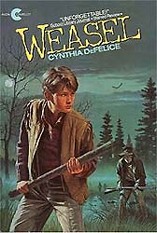
Weasel, by Cynthia Defelice

A continent and many years away from the Jean Little book, 180 degrees different in every way almost, Weasel is about a boy named Nathan and the hard history he comes up against. Set in the American woods soon after Daniel Boone's time, this story tells about Nathan's meeting with Ezra, a man who's lost everything, and Weasel, the man who has taken it from him for no reason but cruelty. Nathan encounters Weasel himself and is forced to examine his own notions of justice....

... And so is the reader.
There were several times in this book where I myself was wondering, what would I do if I were in Nathan's place? It's hard to say, and I'm still not sure. This book isn't stopping short of putting the difficult questions - and the difficult truths - out there.
A key question seems to be: what makes a man good, what makes a man bad? Nathan recognizes that the settlers vilify the Indians. He himself hates Weasel. Weasel, granted, has done terrible things. What does this make Nathan in regards to how he acts towards Weasel?
I'm still thinking... I feel I could write an essay about it someday.
A keenly-written, sometimes heart-wrenching book about one boy's meeting with cruelty - and his ultimately love-affirming response.

Age rec: A man's tongue is cut out and his pregnant wife killed. This isn't shown, and described in little more detail than I've just used, but on Amazon there were some people who disliked the book for that reason. There is, of course, no question about the immorality of such killings and cruelty. The whole book, though, is a pretty in-depth discussion about morality and choices. I would love to use it to teach a class sometime. I personally would say ages 9 or 10 and up, simply because the main point of the story is ethics and a younger child might not understand most of it.

Wednesday, August 31, 2011

Waiting on Wednesday: Brotherband Chronicles - The Outcasts, by John Flanagan

I really didn't have the slightest idea this one was coming out... until all of a sudden I did! I'm suffused with excitement. John Flanagan's books are my indulgent treat: not really the most amazing literature, but so much fun. And terribly funny too.

And a new set of characters! And... sailing! (One of the things near the top of Skills I'd Like To Have.)

Amazon.com blurb:

----
They are outcasts. Hal, Stig, and the others - they are the boys the others want no part of. Skandians, as any reader of Ranger's Apprentice could tell you, are known for their size and strength. Not these boys. Yet that doesn't mean they don't have skills. And courage - which they will need every ounce of to do battle at sea against the other bands, the Wolves and the Sharks, in the ultimate race. The icy waters make for a treacherous playing field . . . especially when not everyone thinks of it as playing.

John Flanagan, author of the international phenomenon Ranger's Apprentice, creates a new cast of characters to populate his world of Skandians and Araluens, a world millions of young readers around the world have come to know and admire. Full of seafaring adventures and epic battles, Book 1 of The Brotherband Chronicles is sure to thrill readers of Ranger's Apprentice while enticing a whole new generation just now discovering the books.

----

Since it gets released November 1st, I foresee another distraction from my NaNoWriMo project...


Waiting on Wednesday is hosted by Jill at Breaking the Spine. I am happy to be finally back on top of things with it, since I've been skipping out for a while.

Wednesday, August 17, 2011

Cart and Cwidder, by Diana Wynne Jones


Wandering players show up a lot in MG fiction, but this one's actually good. Our main character is the youngest son in the family of traveling minstrels, so we see them in much, much more detail than the normal archetype. In fact, the only one who sort of fits that is the father... but the protagonist discovers another side of his before the end of the book.

No, these wandering players aren't a means to take the hero from place to place. Well, actually, they are. (Though their passenger isn't really the hero... but he's still more than he seems.) They're more. We nod at their bringing news from town to town. We feel for the kids trying to keep the show on the road after several chapters have left them by themselves. And then, we see the songs actually come true... to the surprise of the protagonist himself.

Did I mention there's a plot? Did I mention a war and a revolution? At another time, Diana Wynne Jones wrote a very fun Romeo and Juliette; this's her Common Sense (or Les Miserables part II; can anyone give me any famous old stories about revolutions?). And our young protagonist ends up in the thick of it, much to his surprise and chagrin.

There're three more books in this series; I've only started the second. I hope Diana Wynne Jones violated her custom and wrote at least one more about these same protagonists, because I want to hear more about them!

Age rec: MG and up. The mother actively regrets marrying her husband, but it's definitely kept clean and roundly viewed as a bad or at least sad thing.

Incarceron, still by Catherine Fisher

I couldn't help overhearing several scenes when Rina was listening to the audiobook. Between the interrupted wedding and the voyage to the end of the world, I decided to read this book myself. And yes, I got the paper version.

I politely listened while Finn was chained atop the road in the first chapter, but he altogether lost my sympathy when he sprung the trap. "Oh, great," I thought, "another amoral antihero." What restored my interest in Finn was when he freed Attia and left the gang - when he started standing up for morality against his environment! Sure, he falls back sometimes, but he's always trying to break his conscience free from its prison. That's what makes him a hero and a person I'd like to know.

But even before Finn's conscience, the book's environment grabbed me. Despite what Rina said last month, it isn't Victorian. It appears late-medieval. And that's nice and fun; it's almost the Standard Fantasy Environment. Except it isn't. The country isn't late-medieval, it's futuristic under the iron rule of kings who make everyone act and appear medieval! I like this. It adds another layer of depth; it stops me from cringing whenever characters say or do something anachronistic; it turns those times into character- or background-building moments! I still smile whenever I remember Claudia telling her servant, "Just put it through the washing machine. I'm sure you've got one somewhere."

As Rina said, the themes and setting and action more than make up for any deficiencies in characterization. She doesn't delve into themes as much as handle them - they come up naturally in the plot, and the characters address them as appropriate. We don't get any meditations on human nature; we see it in action and we see Claudia and Jared attempting to forge a solution which human nature won't instantly tear down.

And do they succeed? For that, we can see the sequel... I'll be reviewing that later this week, with more attention to the themes and characters.

Saturday, August 13, 2011

Cart and Cwidder, by Diana Wynne Jones

I found this book because, in memoriam sort of, I am now reading more Diana Wynne Jones than I used to. And this looked to be a likely thing.

Book in a nutshell:
Moril's family are travelling entertainers - players and bards. We learn practically on the first page that the country they live in is divided into two rather sharp-edged sections: North and South. The North is a hazy dream beyond the mountains, the South an unpleasant reality where speech and song are censored and the lords of the land can basically do whatever they want.
But while Moril and his family are traveling up and down the South, they pick up a passenger: an annoying, mysterious boy named Kialan. His arrival begins a startling chain of events. After death, desertion, and the authorities are done with them, the traveling cart family has shrunk to only three members. And they know that their only hope is to get North.

This is a simple, straightforward book, a quiet and heartfelt story of family and friends and freedom, twined about with a love for song and words. I never guessed any of the surprises, though, for all its outward simplicity. Each of the people is carefully and almost invisibly characterized - even the musical instruments seem to take part in the story.

Honestly, there's not much I can say about it. All the wonder's in the book itself - it doesn't sound like much to say I love sweet, shy Dagner the composer, or feel sorry for Kialan's rather clumsy attempts to make himself friendly, or thrill at Moril's song at the climax. But it's a book that I can recommend to nearly anyone.

The only thing I could ask for improvement in is the songs - some of them might be a little more, oh, songlike? But that's a picky detail. And besides - I like reading about travelling players. They're a favorite of mine.

Especially when they're also revolutionaries.


Age rec: Anybody. Though it's rather sad at parts, I can't think of a single reason it should be kept away from anyone old enough to hear a good story. Diana Wynne Jones was pretty dependable on for that, with sole exception of the slightly disturbing elements in Hexwood (but that's another story and another post).

Who'd be interested in a Diana Wynne Jones blogweek?

Wednesday, July 27, 2011

Waiting on Wednesday: Goliath, by Scott Westerfeld

Fortunately, this one actually comes out soon.

I've had good experience with "steampunk" even though almost all I've read of it is by Philip Reeve... one of these days, I want to write a blog post about my Reeve-world travels. So I read Westerfeld's Leviathan out of curiosity and found a fast-paced, exciting, clean adventure through a richly-populated world of wonders. Behemoth, the sequel, in no way changed my opinions. And did I mention that I love the Perspicacious Lorix? Both as a character and as a way to get kids to learn a very interesting word.

Anyhow, here's the Amazon.com blurb for Goliath.

---

Alek and Deryn are on the last leg of their round-the-world quest to end World War I, reclaim Alek’s throne as prince of Austria, and finally fall in love. The first two objectives are complicated by the fact that their ship, the Leviathan, continues to detour farther away from the heart of the war (and crown). And the love thing would be a lot easier if Alek knew Deryn was a girl. (She has to pose as a boy in order to serve in the British Air Service.) And if they weren’t technically enemies.

The tension thickens as the Leviathan steams toward New York City with a homicidal lunatic on board: secrets suddenly unravel, characters reappear, and nothing is at it seems in this thunderous conclusion to Scott Westerfeld’s brilliant trilogy.

---

Well, I'm interested, aren't you? I've seen one ARC review that said it wasn't as action-driven as the first two, but I'm not concerned. I trust Mr. Westerfeld's storying ability, and I look forward to September 20th, even though I shall probably have to go on a holdlist for it.

Oddly enough, I consider this series to be MG as well as YA. There's language, but I don't mind it as much when it's "British-ized" slang. The romance (so far) is understated and treated with a light hand.

These books are good clean fun, and the illustrations are just added value.

Saturday, July 23, 2011

Incarceron, by Catherine Fisher

I found the audiobook version of this one because I a) didn't want to wait for the 2 or 3 people ahead of me on the holdlist to read the paper copy and b) had just had my wisdom teeth out and wanted something fun to do. As for the notion of the book itself, I found that it was on the Mythopoeic Award finalist list, which made me interested enough to start reading it one day at Barnes & Noble. After the first chapter and some of the second, I was quite intrigued.

The book in a nutshell (really, this is a terribly unfortunate thing to say if you've read the book!):
Two worlds, or two sides of the same world. A boy named Finn, living mysteriously in a gigantic, sentient prison called Incarceron. A girl named Claudia, caged in a land that disguises its technology with facades of nearly-Victorian era life.

Oh, neeps, I really don't know how to describe this book. It's like trying to summarize The Hunger Games. I'm going to use the synopsis from Goodreads.

""
Incarceron -- a futuristic prison, sealed from view, where the descendants of the original prisoners live in a dark world torn by rivalry and savagery. It is a terrifying mix of high technology -- a living building which pervades the novel as an ever-watchful, ever-vengeful character, and a typical medieval torture chamber -- chains, great halls, dungeons. A young prisoner, Finn, has haunting visions of an earlier life, and cannot believe he was born here and has always been here. In the outer world, Claudia, daughter of the Warden of Incarceron, is trapped in her own form of prison -- a futuristic world constructed beautifully to look like a past era, an imminent marriage she dreads. She knows nothing of Incarceron, except that it exists. But there comes a moment when Finn, inside Incarceron, and Claudia, outside, simultaneously find a device -- a crystal key, through which they can talk to each other. And so the plan for Finn's escape is born ...
""

There; that's better than I could have done at the moment. And it's a book that deserves the best. It's not perfect but it's good, quite good.

I suppose, essentially, Incarceron is a sci-fi dystopia disguised as a fantasy. It feels like a fantasy, and it always does. (I wonder if anyone is ever put off by this? Has anyone spent the whole book waiting for technical details to be discussed, or, worse yet, thought it was the epic fantasy it's dressed up as?)

Thank heavens there's not much romance, I say, thank heavens there's nothing too icky and uncomfortable, and thank heavens there's more than one female character. It's really a large relief to me, this book. I was tired of romance and tired of inappropriate hints or actions. True, a nasty character tries to cast slurs on a protagonist's behaviors with someone else, but the protagonist is as shocked and offended as anyone should be under the circumstances.

Characterization isn't really the strongest, but I didn't care. It's a well-done book, very interesting and fine reading (or listening, as the case may be). Frankly it's action-driven, if not settings-driven. Yes, settings-driven would be the word for it... a book that was the setting in action. I like to write that sort of thing, and I love to read it. The world lives in this book, from the Warden's study to the galleries of Incarceron, from the glass globes in Gildas's tower to the snail-crossed door in the basement. I felt as if the square plastic thing of the audiobook case were my own crystal key, allowing me a glimpse through to a place beyond my ordinary sight.

Talk on the author's website (warning, beware spoilers) says that there is a movie more or less being worked on. I think this book would make a terrific movie, and I for one would watch it - as long as no one put in extra romance.

This book has some subtle and not-so-subtle threads about loyalty and friendship. Is Finn doing right to trust and stand by Keiro so much? Claudia is on Jared's side for a while, but is she risking him too much by the end?
Claudia's two father-figures, Jared and the Warden - how do they each relate to her? How does this correlate with their actual feelings toward her?
What about "protocol"? Is it really solving anyone's problems? Why was it set up, and why does it continue, and is it a good idea? A lot of us like to think about "the good old days" of history, when things were "simpler."How would that really play out?

Quotes are regrettably unobtainable, as it was an audiobook...

Age rec: Honestly, I want to call it MG as well as YA. It's a fairly clean, fast-paced, exciting and mind-bending tale. It won't rock anyone's world, but it's good as books go. My main issues were that, in emotional situations, the characters do air some fairly strong language - and there's some talk of questionable behavior, but it's only approved of by a vile and obviously unsavory character, and Claudia is entirely incensed by the notion.
With a warning for the above, though, I would give it to a ten-year-old.

Saturday, July 9, 2011

Reckless, by Cornelia Funke

I read the reviews; I knew I wanted it. So I had to catch it from the other library that I don't normally go to, since my usual library didn't get it for a while.

This book in a nutshell:
Jacob Reckless discovered the secret of the mirror when he was young, right after his father had disappeared. On his first trip through to the strange, magical world on the other side, he gets his hand bitten by something. It doesn't dissuade him from returning... again and again and again.
The story opens with the disasterous results of his younger brother, Will, following him to the Mirrorworld. Jacob puts years of knowledge to the test as he tries to save his brother from the curse that is turning him into a monster. And it doesn't help that Will's girlfriend has shown up from Earth, curious about the secret that has absorbed the Reckless brothers for so long . . .

Reckless is beautiful and terrible, the world as dark as the cover of the book, the writing as heart-stopping as the action. I found myself reading this one at small group one Sunday night, eating my dinner while I turned pages with the other hand, until one particular situation was resolved.

The female characters don't get short shrift in this novel: there's Clara, Will's girlfriend; Fox, the shape-shifter girl from the Mirrorworld who follows Jacob around; the Dark Fairy, who has a history with Jacob; the Princess, showing surprising character in the end...
I find Jacob and Will's relationship to be quite meaningful. Recently, I've read several books that have this arrangment: the caring, emotionally sensitive brother and the callous, ruthless one; always loyal to each other. Despite having seen it several times, I think it's worth revisiting, and I'm not tired of it yet.

There's no shortage of excitement in this one. It's tense from the first, the tempo ratcheting up like a beating drum, as the situation becomes more desperate. Probably it'll be read in one sitting, so clear your day out!
I found it almost painful to see the chances slipping away, each plan of the characters thwarted, time running out. But it makes it nearly impossible to stop reading.
At the first page of every chapter are graphite illustrations, which I felt added a good deal to the book. It's a beautiful thing, perfectly designed to carry the story it does.

Sometimes I question the middle-grade rating for this one... there's some implied stuff between Jacob and the Dark Fairy, and a lot of violence, and some of the Mirrorworld creatures are downright chilling. Think Grimms' fairy tales, but darker in many ways. If I'd read this when I was ten or eleven, I think I would have felt out of my depth. But that isn't that I wouldn't have liked it. I probably would have.

I believe there will be sequels. At least, from the ending, there had better be sequels. It's not a cliffhanger, but there are unresolved issues. Google "Cornelia Funke Reckless blog tour" and you'll find the author(s) discussing many things, including sequels.

Age rec: There's no good reason why this should be restricted as a children's book. Young adults would enjoy it as well. I would say eight or nine as my bottom limit, ten or eleven being better.

Tuesday, June 14, 2011

The Girl Who Circumnavigated Fairyland in a Ship of Her Own Making, by Catherynne M. Valente

How I found this book: Several reviews suggested that it might be a good thing to read - it seemed so zany, so odd, that I simply had to give it a try.

So... a girl named September is bored with her life, and a person by the name of The Green Wind comes past her house on his leopard and takes her away to Fairyland. Fairyland is both stranger and more familiar than expected, with customs-officers and a city made of cloth and countries where it's always autumn. A witch asks September to go and find her magic spoon for her, as the wicked Marquess has taken it away. September agrees... and with the allied help of "persons" as varied as a Key, a Wyverary (cross between a wyvern and a library), and a soap golem, she embarks on a grand journey which takes her far beyond the capitol city and into far greater issues than a stolen spoon.

I love this book. Its narrative style seems a little stifling in the beginning, but widens out later; either that, or I stopped minding it. It's a slow start, but speeds up in time. The locales and persons described in this book are amazing and detailed, quite beautiful. September knows the sort of thing that's supposed to happen on an adventure like this, and she's quite aware of her situation at all times, comparing her present experiences to her past experiences on Earth.

There are some very weighty issues being tossed around in this book... freedom vs. safety, normalcy vs. adventure, perseverance and hope... I expected this to be a frivolous little narrative, all fluff and fun, but it certainly isn't. Bad things happen. Worse things can happen too. Behind its cotton-candy exterior this book hides some hard stuff.

Thoughts on the ending: is this a good end or a bad end?

I disagree with a few of the sentiments expressed in this book. A) September is required to lie (among other requirements) before she's allowed into Fairyland. B) September is told, and later agrees with, a statement of a questionable philosophy regarding the necessity of clothing. I'm not offended much by either, in the context, but I'm just dropping these statements out there.

Age rec: 8 and up, though maybe with caution for the younger end.

Sunday, May 29, 2011

The Green Book, by Jill Paton Walsh

How I found this book: I was messing around a library one day and happened to see it.

More or less, this book is -
The story of a colony ship of people from Earth departing for a new home planet. They escape a Disaster on Earth that we never learn much about. Eventually they reach another planet and begin to settle in, dealing with issues like reading matter, the possibility of native species, and - most importantly - whether they will be able to grow more food before their supplies run out.

It doesn't sound like much, I will admit - but it is a perfectly beautiful child's book, sweet and simple and a glimpse of a world utterly other and yet peopled with those like us. There's a sense of loss regarding the old Earth, a sorrow as things like literature and clouds are forgotten, when the old stories get garbled. There's the wonder of the planet itself. There's the fear of whether or not survival will be possible.

It's a thin little tale, hardly a novella even at 69 pages.

Quotes:

...and so Shine was transformed. For the buildings at night were now a soft pale green, with points of emerald visible where the lamps were hung, and the leaping glow of the fires made a ruby-red glow in the middle. The blurred and magnified shadows of the people moving inside their houses cast dark figures softly over the walls of the fluted, shimmering green and red shining houses, and Shine at night looked like a scatter of blocks of fire opal, lying on a dark land under the stars.

---

All those years closed inside the spaceship, and the time on the new planet, had made Pattie forget the air could move, the air could touch you, as the quiet air of the new place never did.

----

I love, love, love this book. I suppose it must be science-fiction, but I don't think it feels like it. It's just a child's viewing of a great and strange and wondrous business.

Age rec: anyone. Anyone at all. Even an adult would like it, I think.

Saturday, May 21, 2011

The Underland Chronicles, books 3-5, by Suzanne Collins

This review covers the final three of Suzanne Collins's Underland Chronicles: Gregor and the Curse of the Warmbloods, Gregor and the Marks of Secret, Gregor and the Code of Claw.

These books... must be bad for me... I read the three in a straight row, and completed the last at - it must have been 2 A. M. I picked them all out of the library because I hate waiting for a week to read the next book if I can just take all at once.

Anyone who has read the first two books in the series probably do not require a detailed plot summary. Anyone who has not ought to go read my reviews of book one or book two.
These three are the story of the war in the Underland... the ongoing war between the rats and the humans and seemingly everyone else. The Underland is a very unsettled place, as readers have likely gathered already.
Book 3,
Gregor and the Curse of the Warmbloods, impressed me by being one of the first books that really deals with the mechanics of a kid who has "dual citizenship" in two worlds. Short version: his mom is very much against it, his dad is dubious, and his neighbor is beginning to wonder. But despite all these things Gregor and Boots (with their mom along this time) end up in the Underland once more.
And there's a new problem - a horrible plague that is infecting many creatures of the Underland - including some of Gregor's friends. Gregor and others decide their only hope is to follow another prophecy, deep into the jungle and into places they have hardly imagined...
Books 4 and 5 go on from there, describing the war that is rapidly unfolding beneath the ground, and Gregor's uncomfortably fast-growing part in it...

What do I think of these books? I can hardly say.
First, I do not know whether they are really middle-grade. Now, looking back, I say "this is horrible, they are giving this to little defenseless third-graders?" But realistically, I'm the person who's read
Dragonriders of Pern at the age of nine. Kids are not terribly fragile creatures.
But these are still not for the sensitive child. They are, truly, books written by the author of
The Hunger Games. This seems to be obvious, but... I had not expected Gregor to be so like Katniss by the end. {That is a spoiler, but I don't care. That is a spoiler, but it's one I think may as well be known.}

In the last book there were several places I wanted very much to cry. One, I actually became choked up. Granted, this was past midnight - but still.

Points of discussion:
"Let no good deed go unpunished." What do you think of that phrase? What does that make the deed - is it still good if bad things come of it? Did Gregor make the wrong choice regarding
the Bane? Consequences - Gregor is trying to fix his "punished good deed" - but he still feels pity for the object of his vengeance.
Luxa/Gregor subplot deepens. Is this believable or healthy? I find it poignant to the point of being pitiful. Beautiful but sad.
Gregor's scars, both the physical and the mental/emotional. Adventuring is not all it's cracked up to be, the book seems to be saying. And it's true - drop an eleven-year-old in these situations and what
can one expect to happen to him?

There's a particular chapter ending that breaks me up a little when I think about it. Especially when I remember Luxa's age.
Lay off the twelve-year-olds, Ms. Collins!

{let me suffer for them. Let them be safe. I play with twelve-year-olds down the street, stick-swords and tag and hide-and-seek - I know them. Let them be safe. They deserve safe.}

This is a terribly rambling review, but then, I read them all late - and they do toy with one's emotions.

Some quotes:

The laundry room! While she collected detergent and stain remover from the closet, Gregor tried to think of an excuse for why he couldn't accompany her. He could hardly say, "Oh, I can't go down there because my mom is afraid a giant rat will jump out and drag me miles underground and eat me." If you thought about it, there was almost no good reason a person couldn't go to the laundry room. So he went.

(
... Curse of the Warmbloods)
----

"Pic-a-nic! Pic-a-nic!" sang Boots, drumming on the back of Gregor's head with her scepter. The whole
princess costume thing had been a mistake. Next time he'd get her a coloring book.

(
... Marks of Secret)
----------

Leave it to Howard to think to pack a first-aid kit. It had never even crossed Gregor's mind. Just another reason he was not doctor material.

(
...Marks of Secret)
------

"Slow, deep breaths," said Ripred, and Gregor knew Lizzie must have been having another panic attack. But why hadn't she come to him? Why had she gone to Ripred? "Want to try a few more math problems?" the rat asked.
"No," said Lizzie. "Just want to sit here."
Gregor didn't know what was stranger: to see Lizzie, who jumped at her own shadow, snuggled up against a giant rat, or to see the untouchable Ripred, who seemed to loathe almost everyone, who always slept alone even when other rats were available, comforting his little sister.

(
... Code of Claw)
--------

"Maybe there's still some film in the camera," he said. There was. And since it was an instant camera, they could have the pictures right away. So he held the camera in front of them and they burned through the rest of the roll. For a few minutes, the world outside the museum seemed to go away, and they were just two twelve-year-olds goofing around like they were in a photo booth, making faces, laughing. But when Gregor said "Okay, last picture," something happened.

(
...Code of Claw)

-----

Watch especially out for the paragraph that begins It wasn't much of a letter. Therein lies the part that made me cry almost.

These are dark books. In simple, no-frills language and bare-bones plotting, Ms. Collins makes a wonderful tale full of pain and sorrow and confusion - and love and sometimes even joy. Read them.
I would have eaten these up as a ten-year-old. But I think the ending would have bewildered me because I was a very happy child at that point and had not yet gotten old enough to understand that sometimes people could lose hope.

I had to read from Revelation and Isaiah before I could sleep right after these books. Here behind a link is the Bible verse that always comes to mind when I finish a Suzanne Collins series. I always spell HOPE in capitals when I write it out.

As per last review's complaint: Yes, at LONG LAST someone asks about what happens when people die. Unfortunately, the answer is... unsatisfactory to the extreme.

Age rec: Okay, these are still in the MG category. I would say ten and up. But they contain biological warfare, the attempted killing of an entire race, strong predjudice, unpleasant war, much violence, great danger, great sorrow, and great loss. Admittedly all these are handled well and appropriately. Still...
Be willing to talk with children afterwards, or at the least direct them towards a mature friend who has read the books as well.


Tuesday, May 17, 2011

D.M. Cornish's The Foundling Trilogy v. 1: (Waiting for a Worthy Adventure)

Hello everyone! I'm Rina's brother Evan. She's invited me to be a regular contributer to this book review blog, and I hope to provide my fair share of opinions. Needless to say, though our tastes often overlap (I'm the one who introduced her to her first fantasy book), our reviews do not necessarily represent the other's opinion.

D. M. Cornish's Foundling, the first book in The Foundling Trilogy (originally The Monster Blood Tattoo Trilogy), recounts the journey of young, naive Rossamünd from an orphanage down a pirate-frequented river and through monster-haunted wilderness to a promised job as an Imperial Lamplighter. On the way, he falls in with Europe, a professional monster-slayer, despite his qualms about whether monsters should indeed be killed.

I read this book recently, after seeing it recommended on several different websites and reading an interview with the author on portrayals of religion in fantasy. (Curiously, religion hasn't made an appearance so far... perhaps it will in the sequels.) At the beginning, the protagonist's naivitë and high hopes caused me to nod knowingly awaiting his growth in response to adventures. When the world opened before me, I gasped in awe at the worldbuilding. Unfortunately, the development does not fully live up to this promise. The protagonist remains naivë and passive throughout, and few other characters are developed.

Mr. Cornish's worldbuilding should be a lesson to all authors. The government system is left vague — as it should be; Rossamünd doesn't know much about it — but what is there avoids the twin perils of unrealistically exciting anarchy and oversimplified totalitarianism. A far-off Emperor protects trade through the monster-infested wilderness between mostly-independent city states. Meanwhile, the city states try with more or less success to crack down on local lawbreakers while private fighters supplement the Imperial services by slaying monsters for bounties. Mr. Cornish discusses in tantalizing detail the traditions of the monster-slayers, popular heroes, with intriguing hints that the monsters just might be on the verge of winning the struggle.

The central conflict of the trilogy, I'm guessing, will be the multi-generational war of humans against monsters. Who are the monsters? Where do they come from? I don't know, because our protagonist doesn't. Probably, no human knows — whenever someone tries to understand the monsters from a vaguely-sympathetic viewpoint, he's killed as a traitor. (Yes, Rossamünd does notice what a bad thing this is.) Various characters hint, however, that there's some big secret waiting to be discovered. How do the humans fight? Traditionally, with herbs in mysterious mixtures to repel monsters; more recently, they stride forth to attack monsters with sensory aids and whole new organ systems grafted into their bodies. (It's probably magic, despite the half-realistic treatment of immune rejection, though no character seems to care about the distinction.) These warriors are considered heroes, and their deeds are sung in songs, although many people would be quite nervous to meet one in person. Which side is in the right? It's treason to even ask the question in-universe, but our protagonist is starting to doubt. All this wonderful work keeps me reading attentively, waiting for the next revelation.

This brings me to the main shortcoming of this book: our protagonist never grows enough to phrase the problem in these terms. When Europe kills a monster, he cries out in anguish — why? Because it looked sympathetic while dying. Because Europe attacked first. For all he knew, the monster had killed a dozen babies for breakfast and was about to slaughter ten more when Europe intervened. Yes, Rossamünd who is newly come from a sheltered orphanage might well act like this, but this shows that he is nowhere near heroism. Unfortunately, he doesn't change. He lets himself be swept along by events and emotion without anticipating or planning for the future. This caused my interest to flag at some points - when the protagonist surrenders himself to be a victim of circumstances, why should I care in his stead?

For example, Rossamünd meets Europe the monster-slayer at the end of chapter 6, while walking south to an appointment for his lamplighter job. From there through chapter 12, he only mentions his job once, in passing. His decision to delay his journey and help Europe recover from an illness could be portrayed as admirable charity or reprehensible promise-breaking, but it doesn't even occur to Rossamünd that he's promised to go elsewhere! Even when Europe offers him another job, his previous commitment only passes through his mind once. Mr. Cornish might not have intended to portray Rossamünd as so negligent, but when he apparently ignores his commitments for so many chapters, that is the impression produced in my mind.

I hope all the flaws of this book will be addressed in the rest of the trilogy. Naivë Rossamünd will learn heroism; mysterious Europe's personality will be more fully revealed; everyone will squarely face the question of when monsters should be killed. As a story in itself, this book sadly fails to live up to the promise of its worldbuilding. As a first third of a story, however, this book would probably be an excellent introduction to a protagonist slowly developing in character as he faces a largely-ignored problem. I plan to soon read the other two books of the trilogy, where I hope Mr. Cornish will tie together the threads of the story.

Age rec: I'm not as good at estimating this as my sister is, but I'd say 8 and up. There're a few instances of violence when Europe is killing monsters, as I've already discussed.

Monday, May 9, 2011

Gregor and the Prophecy of Bane, by Suzanne Collins

I got this book from the library because I wanted to read more after book 1....

Skip this if you don't want who lives/who dies spoilers for the first book. Just scroll down, la la la, like I used to do with Mockingjay reviews, and read the review of the first book instead. Better yet, go read the first book itself.

In a nutshell:
Gregor, some months after his first Underland adventure, is finding out that not everything is perfect even though he and his sister and his dad are all back home. His dad is sick, and there's still not enough money. He does, however, have an improved relationship with the cockroaches in his room - and he's got a "job" with a lady downstairs who often sends him home with food for the family.
But then Boots gets carried off by Underland crawlers while Gregor's taking her to Central Park, and Gregor follows - of course.
Down below again, Gregor learns that there's another prophecy, and this one seems to be suggesting that Boots is in danger. And that there's a monster called the Bane that "the warrior" {Gregor} will have to fight....
Once again Gregor has to help his Underland friends, and the journey will take him through some very strange places and uncomfortable situations.

I liked this book very much.
There's still the ghostly feeling of overlay because face it, Suzanne Collins writes like Suzanne Collins, and that means that a bat can get eaten to a skeleton in moments by a cloud of bugs, and a sea serpent can leave poisonous sores on the protagonist's arm that do not heal conveniently in a chapter. But it also means that she knows, somehow, the right notes to play on the reader's heartstrings - or at least on this reader's. I've had that feeling before, both in these books and in Hunger Games - "I'm being emotionally manipulated here. And I don't care, it's beautiful/sad/horrid/amazing anyhow."

Some more beautiful points in this one about... mercy, justice, and acceptance. A strong message against predjudice. Gregor is willing to selflessly risk his life to save someone who is... not in favor at all - when the others refuse to do anything, he climbs over the side of the boat to attempt a rescue.

This book gets into the action a lot sooner than the first one does, probably because the introductions are already over. But... I really must point out, it doesn't exactly end on a cliffhanger, but I can safely say it ends on a hillhanger at least.
So I want the third book. NOOOOWWWWWW.

On the other hand, this is Suzanne Collins's work, and perhaps I don't really want to know what happens? Perhaps vagueness is preferable?
Get ahold of yourself, Rina. These are her MG books. She is not going to kill off a major character.
I think.

One thing I love about this book:
I have met few books recently that hold loyalty, family, and friendship in such high honor. Gregor is not a loner; he is a person with emotional connections and loved ones, and I appreciate this greatly. Especially after Chime, the book I intend to review next.

One thing I am a little annoyed about in this book:
Ms. Collins seems incredibly reluctant to discuss anything even remotely supernatural. We have prophecies, we have special abilities, we have a person who sees the future, we have monsters ... who knows what we'll get later? And yet in all this, we have not even the slightest mention of any Higher Power. On all sides and from above and below there is the threat of death, characters are dying onstage and off, and people are losing those close to them. But no one, no one offers the slightest hint of Life Hereafter, not even tentatively.
And there's this thread in Hunger Games and its sequels as well.
If anyone would be thinking about immortality of the soul or whether there's Someone to appeal to for help, the characters in the plot of a Suzanne Collins book would be.
This is probably my own feelings coloring the issue... but it is getting to me a little. I think that even non-Christians would begin to struggle with these questions in the face of such circumstances, and I wish that such issues was not stared into oblivion in these books.

Age rec: well, I would say 8 and up. Maybe a little more "up." Some violent scenes... and that bat being killed by the swarm of insects... On the other hand, it's pretty conservative in its detail.

Monday, May 2, 2011

Gregor the Overlander by Suzanne Collins

How did I find this book? Well, by reading the other books Ms. Collins wrote, and just wanting more. At first I was apprehensive - I'd had a bad experience where, after reading an author's YA series, I'd gone back and read their earlier (MG) books and found them disappointing. But when I found a hardcover of this for a dollar at a book sale, I figured why not.

I don't know what I was expecting...but I liked Gregor the Overlander. It was no The Hunger Games. But then, it's for a younger audience.* And it was her first book. Reading it was like seeing ghosts, or traveling back in time... I could see her later books overlaid onto this one, and recognize characterizations or style touches.
She has always had her habit of.... making sure people don't set down the book at the end of chapters. To put it mildly.

* I don't mean to be deprecating of books for kids. I think that many of them are at least if not more substantive and well-done as YA books. I just mean that often, there are a lot of differences in books as you go up through the age ranges. And frankly, The Hunger Games is not for kids.

The book, more or less:

Gregor is a kid in an apartment in New York City, taking care of his little sister Boots and his aged grandmother. His mother works, his older sister is off at camp, and his dad is... off in parts unknown. The weather is hot and horrible. Life, at the moment, does not look very good.
Then one day he takes his laundry and his sister down to the laundry room in the apartment building's basement. Boots chases her ball behind one of the washing machines and... disappears. Into a very scary-looking dark hole full of drifting mist. Gregor follows, trying to catch her. When they reach solid ground again, it is a very different solid ground.
The two of them have reached the Underland, a dangerous and intruiging place inhabited by giant bats, huge cockroaches, oversized rats and spiders, and strange humans. And for some reason, they seem to think that Gregor is special. That he's the warrior written about in one of their prophecies.

This is a very fun book for children - though for teens it may require disbelief to be suspended a little more than usual. But it's got heart and danger and thrill and sadness and depth to it as well. There's death, there's loss, there's betrayal, there are hard decisions for Gregor and others to make.
Gregor is an average boy, but he's brave and willing to try his best in hard places, and he's terribly loyal to his sister and his friends. I have enough age difference from him to find him a little immature, but in an adorable way, not an annoying way.

It's not the best-written book, unfortunately. There are a lot of good things, but the plot is hung together a little weakly, and most of the characters are rather sparsely sketched. However, I'd say this is a definite recommendation to ages eight and up, both boys and girls. It's not an immature book at all - as Ms. Collins' fans will likely expect - I for one cannot imagine her writing fluff.

Some quotes:

The platform immediately rose, and he grabbed hold of the side rope to steady himself. Vikus stood calmly with his hands folded before him, but then Vikus wasn't holding a wriggly two-year-old, and he'd probably ridden this thing a million times.

------

"I do not believe in your science," said Henry. "The crawlers are weak, they cannot fight, they will not last. That is how nature intended it."
Gregor thought of his grandma, who was old and dependent on the kindness of stronger people now. He thought of Boots, who was little and couldn't yet open a door. And there was his friend Larry, who had to go to the hospital emergency room three times last year when his asthma flared up...
"Is that what what you think, Luxa?" said Gregor. "Do you think something deserves to die if it's not strong?"

--------

".... You see, I tired of constant fear, so I made a decision. Every day when I wake I tell myself that it will be my last. If you are not trying to hold on to time, you are not so afraid of losing it."
Gregor thought this was the single saddest thing anyone had ever said to him. He couldn't answer.
"And then, if you make it to bedtime, you feel the joy of cheating death out of one more day," she said. "Do you see?"

--------

"Fascinating as your native rituals are, do you think we might proceed in silence? Given that the entire rat nation is on the lookout for us, it might be prudent," said Ripred.

I do rather like this book. I think I would have adored it if I read it when I was younger. But even now I know that it's pretty good for those who are younger. I intend to lend it to a little friend of mine who is a bit too interested in The Hunger Games than she probably ought to be yet.

Friday, April 29, 2011

The Night Children by Kit Reed

I found this book in the library "mystery" section though it's really not much of a mystery story. I have a soft spot for the kids-on-their-own, clans-and-kingdoms story.

Before I begin I simply must share the opening lines:

When you walk into the mall you expect to come out at the end of the day.
You expect to come out, at least, but it's midnight and Jule Devereaux is locked in a car at the top of the gorgeous WhirlyFunRide, high above the sprawling Castertown MegaMall.

In a nutshell: not really a mystery, but a thriller. Not really fantasy, though quite fantastic. Not really moralizing, but has some very definite morals.
A bit more detailed: The titular Night Children are the runaways {like urban Lost Boys except girls too} who lost their way in the MegaMall and were never reunited with their parents. At least, that's what most of them are.
The MegaMall is the dream of Amos Zozz, the fabulously rich, secretive owner. He seems not to know about the children... or when they're brought to his attention, he pays no heed.
But many of the people connected with the building of the MegaMall have mysteriously disappeared, including Jule's parents. Jule's had an argument with her aunt, and now her aunt is missing as well. She goes to the MegaMall and rides the WhirlyFunRide...too long. It shuts down and she is locked in there for the night. Or so she thinks.
Because the Night Children are on the move, and things are happening, and mysteries of the MegaMall are going to be revealed.

I actually loved this book. For some reason it reminded me of A City in Winter by Mark Helprin; the same fantastic reality, ever so slightly unreal and overblown. The writing style was more Philip Reeve, with its chatty, almost gleeful, enthusiastic/serious narrative.

I must say that, like I said, I am a real softie for children-on-their-own plots. But this one was much more. If anything, I only wish it had been longer. The plot was a little too hurried to really get at all the depths of the intriguing characters that were in it - I felt we were thrown too quickly through the action to get to know them as well as we could have.
Also, there is a bit of an unsatisfied plot thread left at the end... I am understating.

A quote:

...had been captured, Jule said, "He wanted to hurt me. Why should I care what happens to him?"
Tick added, "You want me to risk everything to save a guy who wants to ruin us?"
"Right," Jule said. "Why should we care when I could care less?"
...."Because that's what kids do for kids. We have to help each other, no matter what."
She started, "Even after he tried to..."
"Yes." Tick let her go and stood back. "It's what I do."

Can I express how much I like that attitude, in the avalanche of self-serving little protagonists who cheer at their enemy's downfall?
And I must say, it has a harsh message in the end against consumerism. Of course, that seems not too hard to work in, but it's there.
There's a very villainous villain who's motivated by... hatred and revenge, mostly insane. Must say that's a good thinking point, though - what do we do when people do truly terrible things to us? And are unrepentant? Do we nurse the anger or... leave go and free ourselves?

Age rec: the V. V. V. (very villainous villain) in his insanity proposes some fairly awful things... but since the entire book is unlikely to the extreme {or is it? must ponder this, esp. since I've been to the Mall of America} I don't think it would be a problem. So this one is MG and up. Would make a nice readaloud, I feel, too.

It's not often I tag a book "stellar" on its first reading, but this one has hit me right where I wanted to be hit, and I love it. Of course, I have a succeptibility to this sort of plot, since it's the only sort of hero I feel I could be: a hero who takes care of the others.

Note: Tick also is the first book character I know to use my people as a term to describe the children who depend on him. I say it in my stories and in real life, so this was another point that really touched me.

Thursday, April 28, 2011

The One Left Behind, by Willo Davis Roberts

I found this book at the local library and decided to try it out.

This book, in a nutshell:

Mandy, an eleven-year-old girl whose twin sister has recently died, is left alone in the family house for the weekend. She is initially pleased that she's managed to convince everyone that she's with someone else, but when she hears strange noises the first night, she begins to question whether this was such a good idea after all.
Mandy and her dog Herry investigate the next morning and find a wrecked van in the woods... and then they find more than that... they find a wild adventure the likes of which Mandy has only met in her made-up stories.

I was not wowed by this book - it needed to be longer. The ending was not satisfactory, with a number of things left hanging. Also I got the impression that the book was a jumble of different things all thrown together with a slight lack of cohesion: Mandy's grief, her uncle's mental problems, the boy in the woods and his story...
But then, this book was published posthumously, and I imagine that Ms. Roberts may not have had the chance to do all the revisions she wanted. So I allow slack for that.
It's a simple and well-written tale, though, and the opening chapters are quite good. The descriptions of noises in the night captured exactly what it feels like to be awake and hearing things.

Age rec - eight to fifteen. A sweet book.
Mandy's faith is not discussed often, but there is a mention of God answering prayers that I find quite touchingly written.

I hope to read more of Willo Davis Roberts's books when I can, to see what the others are like. The dustjacket says that this was the 100th book of hers published.

Saturday, April 23, 2011

Mara, Daughter of the Nile by Eloise Jarvis McGraw

All credit to the discovery of this book goes to my mother, who read it to my brother and I when we were younger.

Historical fiction, as you've probably already learned from my blog, is not a genre I often get excited about. It's a wonderful genre and needs more good books, but what's in it now is not always that great.
By which same token, this book was originally published in 1953.

So what's it about?
Mara, Daughter of the Nile is about a revolutionary, and a revolution; about the Pharoah Hatshepsut who is not a good ruler, and the imprisoned Prince Thutmose who some believe could be. But it's also about Mara the slave-girl, brilliant and street-smart and tricky and proud and somehow utterly engaging. She is sold to an agent of the Pharoah and told to act as a spy for them, and then finds herself caught up in working for the other side, for the revolutionaries.
At first she intends to please her new master and turn the revolutionaries in... but the leader of the revolution is a young man named Sheftu, and Mara finds herself disliking the idea of causing his death...

This is an amazing book. Yes, it is a romance. But it's also an espionage story, a political story, a revolution story, a story set in the vivid and far-off world of Ancient Egypt. It's incredibly well-written and action-packed enough to satisfy anyone.
As one of my friends (Sylvia let's call her) said just a few days ago, "It looks like one of those books your parents give you for your education. But it's good!"

Some quotes:

...He gave Nekonkh a moment to absorb that thought, then added casually, "So you would overthrow the queen?"
"By the Feather of Truth, I said no such thing!" gasped Nekonkh. He darted an agonized glance up and down the deck, then strode to a deserted spot in the bows.
Sheftu followed, his face amused. "A wise precaution.... They say the queen's spies are everywhere."
"No doubt!" Nekonkh was convinced he was talking to one that minute.

--------

"Egypt is not pharoah, Mara, nor is it this long, green valley with its black mud that is so different from what I know. Egypt is neither the Nile nor the cities - "
"Then what is it?"
"You, Mara."
"I?"
"And all the others - the people, all those you have told me of, and the fishermen yonder on the river, and the potters and carpenters and their like... - and their friends, and their kin...."

-------
{Writing that last quote makes me want to cry because of a certain later part.}

Perhaps you've gathered by now how much I love this book. I think it should be on everyone's list. It does also make an excellent read-aloud.
Age recommendations: anyone old enough to appreciate a good thrilling plot. There's some kissing and some violence, but I was about nine years old when I read it, so I don't think it's a problem. People do swear by the Egyptian gods; I don't find that offensive, but some might. Parents worried by any moral ambiguity of the protagonist may relax in the fact that things do change by the end.
In fact, (highlight for hidden spoiler) Mara's final decision to keep her word and be selfless is what saves the day in the end. Don't think I'm a wimp, but I honestly find those parts near the end almost heartbreakingly wonderful.

What are you waiting for? Go forth and read.

Monday, April 18, 2011

There will come more reviews

I am planning an en masse review of Susan Cooper's series The Dark Is Rising; all I have to do is finish Silver on the Tree. Some of my comments include:

- Opinion on the "mind-control/memory-clearing" that the Light practices? I am yet undecided whether I approve of it or not, and I think I don't.

- Is it only me, or is The Grey King a quite superior book to the first three?

- I want to learn Welsh and go to England!