Sunday, October 23, 2011

The Scorpio Races by Maggie Stiefvater


How I found this book:
I detested the beginning of Shiver but remembered the odd name of the author; when I saw this book on the New Teen Books display at the library, I scanned it (must have been only the back cover excerpt?) and brought it home in one of the most trusting book-obtaining sprees I have ever gone on. I don't know what got into me, really. But this time it worked...

To be open and up-front with you, readers, I am 100% wowed with this book. I am buying myself a copy. I may also get horseback riding lessons. Who knows?

And I love the cover, too.

Book in a nutshell:

The island of Thisby (apparently supposed to be somewhere off the English or Irish coast) has one unique thing, one terrible and beautiful thing that sets it apart. It has the capaill uisce, the water horses, that come out of the sea in late autumn - the horses who eat meat, who kill humans, and who run like the wind.
The Scorpio Races is a yearly event on the first of November. In the month before, as the capaill uisce come up, people begin to train and ready for it. But this isn't a horse race. This is a water horse race, along the beach, fighting to control your magical mount and not be attacked by anybody else's on the way.
This is the story of two competitors: Puck Conolly, a stubborn girl hoping to win the race so as to earn money to save her family's home, and Sean Kendrick, a young man who rides a capaill uisce that belongs to him in all but lawful contract. The stakes are high, and the training season is beginning.

---

The Scorpio Races is a heartwrenching, beautiful, fast-paced book with just the right amount of everything. It's for horse-lovers and fantasy-lovers and action-lovers - if you're looking for just a romance, there's one here, too, though it's pretty subtle compared to many out there.

This is a very well-written book. Ms. Stiefvater doesn't waste words, but she scatters them well; the Festival scenes were especially well-done. Though the dual-narrators thing occasionally left me confused as to who the "I" was at a given point, I didn't count points off. It was a good way of telling the story - in fact, the best that I could think of.

The capaill uisce (Author's Note assures us it's pronounced CAPple ISHka) especially resonated with me, as I have a peculiar mix of love/fear feelings toward horses. I never had too much experience with them, and I doubt I'll ever lose my slight wariness when around them. Even though these are fantasy horses, I felt that I could transfer some of the characters' feelings to apply to real-life horses: respect, admiration, excitement, sometimes love, occasionally a degree of trust, an understanding of the power of the animal and the potential harm they can inflict. (If you are a horse lover, please understand I do not mean to insult domestic horses. I've met many lovely horses in my life and know that most of them are perfectly friendly. But I respect them, their size, and their occasional unpredictable behavior.)

It's a story about losing things, or being on the brink of losing them, or considering whether you have them at all. Puck's brother Gabe wants to leave his orphaned brother and sister and go to the mainland. Sean wants his own life, outside of the stable where he's been working for nine years, and most especially wants to own his capaill uisce Corr for himself. Puck wants to keep her life together and not lose the house - or her brother Gabe. Odious Mutt Malvern wants something... the lovable Dory Maud and her sisters want something... Some wishes are possible, some seem impossible. Some are granted, some not.

Another interesting theme is Puck herself. She's not only the first girl to run in the Scorpio Races, but also... an atypical entrant in other ways (avoiding spoilers here). She undergoes all kinds of attempts to get her to withdraw her entry, attempts made by people with reasons ranging from tradition to sheer meanness. And when she's asked at one point whether she was "inspired by the women's suffrage movement," she answers, "I'm just a person with a horse, same as anyone else on this island." True. I don't see Puck as a feminist. She's not trying to be revolutionary; she's just being herself.

I also noticed a strong thread about home and belonging. Sean dreams of having his own farm. Puck wants to keep living in the house with her brothers. They belong on Thisby - they belong to Thisby. But others - such as Gabe and his friends - speak of not being able to stand the island, of wanting to leave. And then there are the tourists, including George Holly, who love Thisby but only for as long as the exciting races are going on.

I could hardly put this book down. Nearly every suspicion and guess I had about plot outcomes was disproven. Ms. Stiefvater made a bright, dangerous, living little world that I'm sorry to leave, even though I half-imagine it's going on still while I have my back turned! My heart went out to many of the characters. For a moment I even felt sorry for Mutt. But this is a book of hope, as well as loss, and the last page brought tears (of joy) to my eyes. (Yes. Rina, who didn't cry during any of the Hunger Games books, cried at the ending of The Scorpio Races. Finish it, and you'll see why to.)

Age rec: I'd say 13, 14 and up. There are some references to things, but nothing I considered terribly embarrassing - a little swearing, too - and the romance is surprisingly light (esp. considering what I've heard of the author's previous work). The worst that can be expected are the rude insults and ragging that Puck receives as persecution from hostile islanders. I can definitely recommend this book for boys and for girls, for teens and for grownups.

Sunday, October 16, 2011

Wildwood by Colin Meloy


How I found this book: Well, seeing the title of this post, you will probably go, Oh no, not another Wildwood review! That's the answer. A lot of people reviewed it. They said enough things about it that I wanted to read it.
I also got stuck with it for a while because my library temporarily closed shortly after I took it out.

(Picture of cover from the author's website)

Book in a nutshell (hard to do, since it's about an inch and a half thick):
Prue McKeel's an average Portland, Oregon, girl. She's good in school, loves her family, and stays away from the Impassible Wilderness - that great empty blot on all the maps of Portland, the forest that few ever enter. Then one fateful day, her little brother Mac is abducted in the park by a flock of crows (a murder of crows, as the book mildly calls it, using what I believe is the proper term for such a congregation). At the edge of a cliff and panting from a bike chase, Prue sees the black shapes disappearing down into the far-off pines of the Impassible Wilderness.
The next day, she sets off, with her suspicious classmate Curtis in pursuit... after all, if you were a rather geeky young boy (to borrow the colloquialism) with an interest in books, and you saw an acquaintance of yours disappearing off to potential adventure, wouldn't you pursue too?
Inside, the Impassible Wilderness turns out to be a divided land inhabited by talking animals and odd people. And it's a land of danger and misfortune, of instability, that the two children find themselves in. The coyote soldiers of the Dowager Governess are ruthless, but are the bureaucrats of the South Wood even worse? And while Prue's definitely out of patience with the latter, what's going to happen now that Curtis is allying with the former?
Not to mention, how is Prue ever going to find Mac?

----

I did like this book. I keep thinking that it's like Narnia... but it isn't... why do I say it is? Because of the children, I suppose, and the talking animals, and the comparison someone made between the Dowager Governess and the White Witch.

(For what it's worth, I agree with the comparison. Not to mention, in many ways Curtis seemed to be running a parallel of Edmund. Who would that make Prue? More like Peter than any other, really.
Seriously, though, there are too many parts of this story that have no Narnian counterpart for me to really present a comparison on a large scale. The bandits, for example!)

The scenery is beautifully described; this book is a subtle paen to a beloved Northwest Coast landscape... which I have visited before and love as well.
There's a very rich cast of characters, as might be expected.The Bandit King is part Aragorn and part.... I don't know, maybe part cowboy? He - and his band - are quite human, believable, flawed, and yet fun. South Wood's bureaucracy is portrayed dryly in all their chilling, impersonal straitness. Owl Rex and his eagle General are heroic figures, Enver the sparrow a nervous patriot. In fact, every character, even the bit parts like housemaids and bandits in prison, is lovingly crafted and handsomely portrayed.
The characters, in my opinion, are the crowning glory of this book, and make a far-fetched story feel as real as next door.

Both Prue and Curtis show realistic, well-written character development throughout the book, unlike many MG heroes and heroines these days. I find myself falling back onto the Narnia analogies: Prue becomes a leader like Peter, if not a warrior, and Curtis comes to an understanding, like Edmund, of what's really up. I love them both, really. I'd be proud to be friends with either of them.

Oh, there are oodles of things I love about Wildwood! But...

My main problem began around page 328. It would be a major spoiler to say exactly what it was, but... I was very displeased with the sudden influx of Magic into the story, especially in the way that it happened.
Highlight below for a spoiler that explains why I was displeased:
It is revealed that the Dowager Governess made a deal with Prue's then-childless parents: she would cause them to have a baby (exact words: "I'll make you with child") if they promised to give their second child (if there ever was one) to her. A sort of Rumplestiltskin bargain, except worse. Admittedly, since it was "a few weeks later" that a doctor stated Prue's mother was pregnant, one could take the notion that the "Wood Magic" merely removed whatever was keeping her from being pregnant - but really. Moreover, IF a character learned that she'd basically been concieved by the magic of a nasty villain, I think she WOULD be somewhat more shaken about it. So it's a plot problem as well as a very weird and unpleasant idea.
And again, when we meet the Mystics at the Council tree, suddenly everything takes a flip into Eastern-religion-style meditation and "Wood Magic." The Mystics take a major role in many things from there on out, and the trees and bushes begin to be partly sentient when meditated with, and... Wood Magic becomes a sort of deus ex machina.
I was disappointed. We had such a great set-up (what with the Bandit King and his lot, and the birds, and the talking animals and the bureaucrats and everything!) and now, suddenly, a needless Magic shows up - and of a sort that I found completely unsuited to a Portland, OR, setting and barely foreshadowed.
Wood Magic becomes a sort of deus ex machina, especially taking a role in the climax when (spoiler) Prue harnesses her powers and convinces tree branches to save her brother from the Dowager Governess's deadly plans.

Final thoughts:
Wildwood is a modern, MG epic that, unfortunately, seems to fall short in some plot features. If the magic had simply been left out and a few elements re-worked to compensate, I would have considered it stellar. I'm longing to talk about all the things I love about it, but at the core it was a bit of a disappointment. I'm sorry. I want to like it more. It's good now, but it could have been great.
If it had fallen short in more ways, I wouldn't have felt so bad about where it did. The trouble is, until around the 300-page mark, I was set up for an American Narnia! Then, instead of Aslan, we end up with meditation and one-with-the-earthness. Frankly, I would have preferred a lack of any spiritual elements at all. I wasn't expecting any, but then they showed up.

But if you're reading this review and scratching your head saying, "What's she griping about? Sounds great to me" then by all means go read Wildwood. You will love it.

Age rec: Well, I guess MG. 10 and up. And up, and up! But with a warning regarding all of the above. The battle scenes are not bloody, and there's no bad swearing that I recall, and definitely nothing of the adult-content variety. Really, except for the odd Wood Magic... but I've been over that already.

N. B. - the Impassible Wilderness seems to be based off a real park in Portland: Forest Park. Take a look on Mapquest - the thing's huge!

Sunday, October 2, 2011

Upcomers

Dancing around an Upcoming Books post on Charlotte's Library, I discovered a few that I'm interested in.


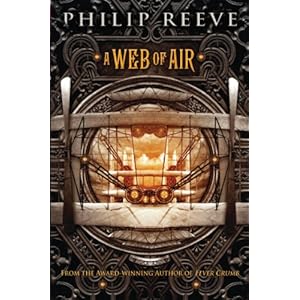
I really haven't got a great fancy for Reeve novels, but I may end up reading this one, if it receives good reviews. Fever is my favorite of his characters. I wonder if Kit's children are in this book too?

Frankly, anything about poor Kit Solent is a very poignant pleasure - you see, I have read the Mortal Engines series since Fever Crumb, and.... anyone who has read those knows what I mean. (Insert mournful noise here).


This one deserves its biggest picture.


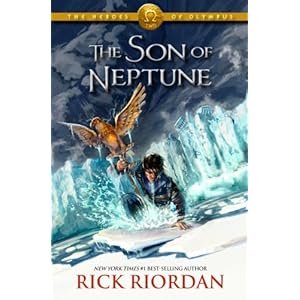
I'm not much of a Rick Riordan fan. I read Percy Jackson books 1 - and 5. Nothing inbetween, except for a chapter or so at the beginning of book 2. Book 1 did not interest me. But then, probably I'm not expected to appreciate a tale issued for middle school boys.
Book 5 (The Last Olympian) impressed me a good deal. "The years," I said, "have added age and perhaps even wisdom to these characters!" Yes, but the years had also added power and depth to Rick Riordan's writing. Not so much that I will play catch-up with the other books in the series, but enough that I had a very good time reading The Last Olympian.

A younger friend of mine - the same one who lent me the first and fifth Percy Jackson books - proceeds to incite me to read the new serieses. I've been dubious.

However, this cover deserves to be printed and framed.

Wednesday, September 21, 2011

Waiting on Wednesday: Liar's Moon, by Elizabeth C. Bunce


I read Starcrossed with initial reluctance. The protagonist seemed disappointingly selfish and shallow at first, but as the plot thickened, she grew ever more lovable and understandable. By the end, I thought the whole book was great, the protagonist a friend of mine, and Elizabeth C. Bunce a master of the art.

Needless to say, I want the sequel.

Amazon.com blurb:

---------------------
Prisons, poisons, and passions combine in a gorgeously written fantasy noir by the author of the Morris Award-winning A CURSE DARK AS GOLD.

As a pickpocket, Digger expects to spend a night in jail every now and then. But she doesn't expect to find Lord Durrel Decath there as well--or to hear he's soon to be executed for killing his wife.

Durrel once saved Digger's life, and when she goes free, she decides to use her skills as a thief, forger, and spy to investigate his case and return the favor. But each new clue only opens up more mysteries. While Durrel's marriage was one of convenience, his behavior has been more impulsive than innocent. His late wife had an illegal business on the wrong side of the civil war raging just outside the city gates. Digger keeps finding forbidden magic in places it has no reason to be.

And it doesn't help that she may be falling in love with a murderer . . .


-----------------

Since I can't remember most of the names from Starcrossed, I think I need to re-read it. But that will be a welcome pleasure in and of itself.

Liar's Moon (can I say I LOVE the title, esp. considering some points from book 1) comes out on November 1st.


Waiting on Wednesday is hosted by Jill at Breaking the Spine.

Tuesday, September 13, 2011

Two very beautiful MG novels

A double post today! Both of these came from my library, when I was browsing the younger section for something pleasant.

Dancing Through the Snow, by Jean Little

This is the story of Min: early memories of a callous, abusive pair who weren't her parents, abandoned in a public place, in and out of foster homes for years. Now, a little while before Christmas, she's been returned to the social services office again after another placement that didn't work out. But a new chance comes, in the form of Jess Hart, a doctor who helped her when she was younger. Jess, with a characteristic disregard of red tape, sweeps Min away to her own home. And this begins a new life for Min - full of unexpected complications, like an abandoned dog, a puppy-mill investigation, and an irritating boy named Toby, as well as with surprising joys.

At its heart this is a simple, gentle book about a girl finding her place in the world. Each of the characters is lifelike, from caring Jess Hart to even the difficult Toby. There's no earth-shaking conflict or excitement in this book, but there's all sorts of beauty, and the small decisions of right and wrong, good and bad. I felt that this book could really have happened - and stories like it probably have, before.

Age rec: anyone. The more unpleasant aspects - Min's difficult early life, the puppy mill - are, if not ignored, "lightened" for younger readers. And I myself was moved almost to tears at several points, including the ending.


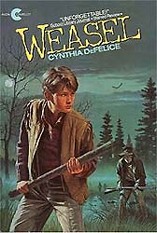
Weasel, by Cynthia Defelice

A continent and many years away from the Jean Little book, 180 degrees different in every way almost, Weasel is about a boy named Nathan and the hard history he comes up against. Set in the American woods soon after Daniel Boone's time, this story tells about Nathan's meeting with Ezra, a man who's lost everything, and Weasel, the man who has taken it from him for no reason but cruelty. Nathan encounters Weasel himself and is forced to examine his own notions of justice....

... And so is the reader.
There were several times in this book where I myself was wondering, what would I do if I were in Nathan's place? It's hard to say, and I'm still not sure. This book isn't stopping short of putting the difficult questions - and the difficult truths - out there.
A key question seems to be: what makes a man good, what makes a man bad? Nathan recognizes that the settlers vilify the Indians. He himself hates Weasel. Weasel, granted, has done terrible things. What does this make Nathan in regards to how he acts towards Weasel?
I'm still thinking... I feel I could write an essay about it someday.
A keenly-written, sometimes heart-wrenching book about one boy's meeting with cruelty - and his ultimately love-affirming response.

Age rec: A man's tongue is cut out and his pregnant wife killed. This isn't shown, and described in little more detail than I've just used, but on Amazon there were some people who disliked the book for that reason. There is, of course, no question about the immorality of such killings and cruelty. The whole book, though, is a pretty in-depth discussion about morality and choices. I would love to use it to teach a class sometime. I personally would say ages 9 or 10 and up, simply because the main point of the story is ethics and a younger child might not understand most of it.

Wednesday, August 31, 2011

Waiting on Wednesday: Brotherband Chronicles - The Outcasts, by John Flanagan

I really didn't have the slightest idea this one was coming out... until all of a sudden I did! I'm suffused with excitement. John Flanagan's books are my indulgent treat: not really the most amazing literature, but so much fun. And terribly funny too.

And a new set of characters! And... sailing! (One of the things near the top of Skills I'd Like To Have.)

Amazon.com blurb:

----
They are outcasts. Hal, Stig, and the others - they are the boys the others want no part of. Skandians, as any reader of Ranger's Apprentice could tell you, are known for their size and strength. Not these boys. Yet that doesn't mean they don't have skills. And courage - which they will need every ounce of to do battle at sea against the other bands, the Wolves and the Sharks, in the ultimate race. The icy waters make for a treacherous playing field . . . especially when not everyone thinks of it as playing.

John Flanagan, author of the international phenomenon Ranger's Apprentice, creates a new cast of characters to populate his world of Skandians and Araluens, a world millions of young readers around the world have come to know and admire. Full of seafaring adventures and epic battles, Book 1 of The Brotherband Chronicles is sure to thrill readers of Ranger's Apprentice while enticing a whole new generation just now discovering the books.

----

Since it gets released November 1st, I foresee another distraction from my NaNoWriMo project...


Waiting on Wednesday is hosted by Jill at Breaking the Spine. I am happy to be finally back on top of things with it, since I've been skipping out for a while.

Sunday, August 28, 2011

Five books, five words each

I wanted to have a say about the books I've read recently/am reading... but I don't feel as though all of them could be reviewed at length. So I'm trying something new.

Five books I've read in the past week or so, five words each...

Wizards at War, by Diane Duane (Young Wizards series #8) -
Brilliant, stunning, powerful. Series's best?

Drowned Ammet by Diana Wynne Jones (Sequel to Cart & Cwidder) -
Not light reading. First better.

Blood Red Road by Moira Young (See my long review) -
Post-apocolyptic hero tale in dialect.

The Spellcoats by Diana Wynne Jones (Prequel to Cart & Cwidder and Drowned Ammet) -
Liked the weaving. Book drear.

Falling from Grace by Jane Godwin -
Strange. Characters flat, foolish. Disliked.